01. 10. 2026
DevOps, Kubernetes, NetEye

16. 10. 2026
Marco Pergher
NetEye, NetEye Conference
NetEye Conference DACH: 4 Key Takeaways on IT and Cybersecurity
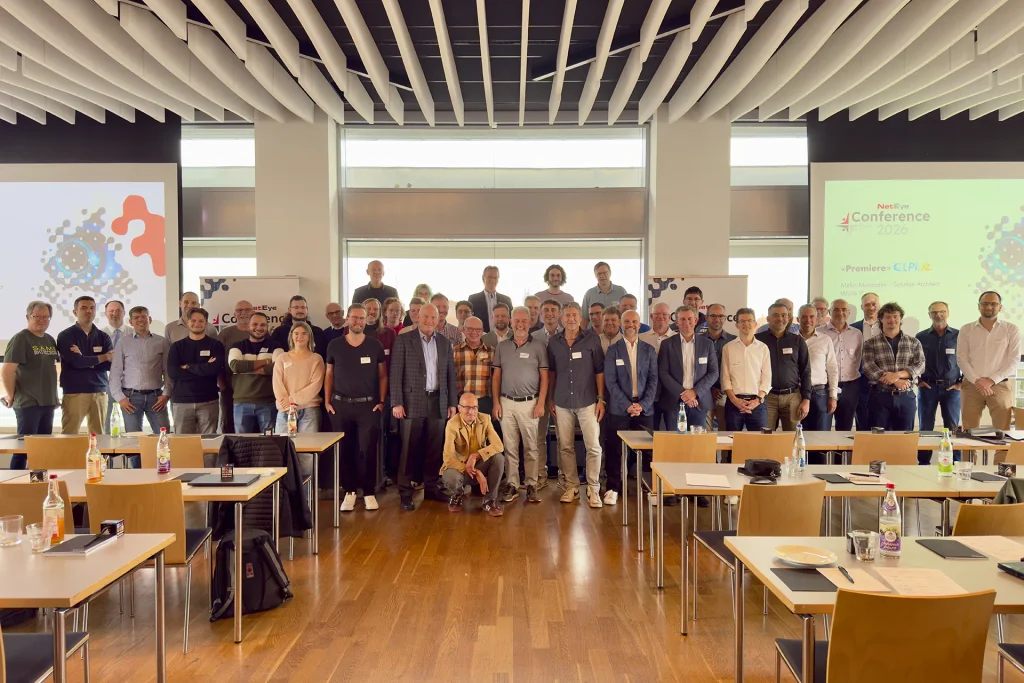
What happens when Monitoring, Observability and Cybersecurity are no longer treated as separate disciplines?
How can organizations gain a better understanding of complex IT environments? How can they identify relevant threats at an early stage? And how can they turn growing volumes of data and alerts into informed decisions?
These were some of the key questions at the NetEye Conference DACH, held in Nuremberg on October 8th. Marking its tenth anniversary, the event welcomed more than 70 participants to KORN’S for the first time, bringing together professionals to discuss current challenges in IT Operations and Cybersecurity.
One key takeaway quickly emerged: Individual tools and data provide valuable information, but their real value lies in connecting the dots, assessing risks accurately, and translating insights into specific action.
4 key takeaways from the NetEye Conference DACH
- Connect the dots: Network data and Observability provide greater visibility into complex IT environments
- Assess threats earlier: Effective Cyber Defense combines technical analysis, Threat Intelligence and human expertise
- Make processes work: IT Service Management translates requirements into clear, structured workflows
- Prioritize what matters: The goal is to distinguish meaningful signals from unnecessary alerts
Improving visibility and understanding dependencies
Modern IT environments consist of numerous systems, applications and dependencies. Individual metrics are often not enough to identify the root cause of an outage or performance issue.
The conference highlighted how network data and Observability can help organizations understand these interdependencies. Robert Cowart, CEO and Co-Founder of ElastiFlow, explored how network data can support the assessment of stability, performance and security. Georg Kostner, Head of the Cyber Defense Center and IT System & Service Management at Würth IT, focused on Next Generation Observability, with particular attention to visibility across Kubernetes environments and modern data platforms.
The common approach is to look beyond isolated data points and assess information in context. This makes it easier to understand dependencies and investigate issues more effectively.
Identifying risks and taking a holistic approach to Cybersecurity
Cybersecurity doesn’t begin just when an attack is detected. Organizations need to understand their exposure, assess threats and prepare for different scenarios.
The conference explored these challenges from several perspectives. Michael Sjøberg of Delta Crisis Management shared insights from real-world cyber extortion cases, explaining how attackers operate and how negotiations unfold. Tobias Goller of Würth IT examined the relationship between people, artificial intelligence and the Security Operations Center (SOC).
Other sessions addressed the requirements of the Cyber Resilience Act (CRA), research into autonomous malware, and the use of Threat Intelligence and Exposure Monitoring. Günter Aigle showed how SATAYO combines threat intelligence, monitoring of exposed company assets and analytical expertise to support a more informed assessment of cyber risks.
Together, these topics highlight what effective Cyber Defense requires: technical visibility, in-depth analysis and the ability to prioritize the right actions.
Turning information into action
Visibility and risk analysis are essential starting points. The next step is to translate insights into effective processes and concrete measures.
Marco Stecher, IT Manager at hollu Systemhygiene, presented a practical example of using GLPI for IT Service Management. Mirko Morandini, Solution Architect GLPI at Würth IT, also introduced GLPI 12, which made its German debut at the conference. New features include a Knowledge Base and enhanced search and viewing options.
Alert management is another key part of the picture. In his session “Nobody Ordered 4,000 Alerts”, Blerim Sheqa, COO of Icinga, addressed a familiar challenge for many IT teams: Dealing with high volumes of alerts while identifying the ones that genuinely matter.
More information doesn’t automatically lead to better decisions. What matters is understanding which signals are relevant in each context and determining the right response.
Ten years of exchange on IT Operations and Cybersecurity
The tenth NetEye Conference DACH brought together professionals, technology providers and users to discuss topics ranging from Observability and IT Service Management to Cyber Defense, Threat Intelligence and emerging regulatory requirements.
The common thread was how organizations can gain a better understanding of their IT environments, assess risks with confidence, and respond to relevant events. Monitoring, Observability and Cybersecurity are not isolated disciplines. When considered together, they provide a stronger foundation for managing and securing complex IT environments.
Thanks to Gravitate for organizing the event, to all speakers for sharing their expertise, and to the participants and partners for the exchange in Nuremberg.
After completing a course focused on Velociraptor, I personally found it useful to summarize its main components and explain how they can be used during threat hunting and incident response activities.

Marco Pergher
Author
