16. 10. 2026
Events, NetEye, NetEye Conference

28. 10. 2026
Marco Pergher
Events, NetEye, NetEye Conference
Highlights from the NetEye Conference Italy 2026: AI and Human Insight in IT Operations
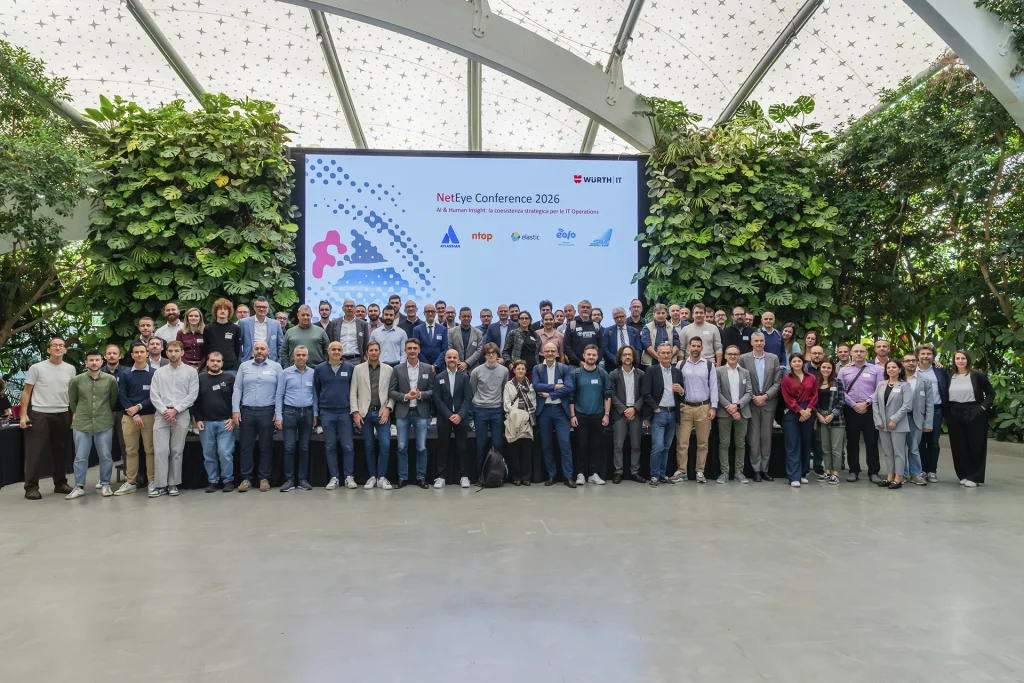
What happens when Artificial Intelligence becomes part of everyday IT Operations? Where can it help teams work faster and see more, and where do human expertise and judgement remain essential?
These questions shaped the NetEye Conference 2026, held at the Crowne Plaza Verona – Fiera on 22 October. Under the theme “AI & Human Insight: the strategic coexistence for IT Operations”, the event brought together 130 participants to discuss the changing roles of observability, cybersecurity and service management.
The central message was clear: AI can help teams analyze information, identify patterns and automate routine work. But useful outcomes depend on people setting the right priorities, validating results and deciding what action to take.
4 key takeaways from the NetEye Conference Italy
- Put AI to work alongside people: AI can support analysis and automation, while human expertise remains vital for context, validation and decisions.
- Expand observability: Connect network, infrastructure, and application insights-including those needed to understand AI systems-to see issues more clearly.
- Make cybersecurity intelligence-led: Prioritize the questions and risks that matter instead of collecting information without a clear operational purpose.
- Turn service insights into action: Use automation to make workflows more efficient, while maintaining governance, reliability and a focus on users.
From the main stage: global perspectives, NetEye vision and network intelligence
The main-stage programme opened with a Key Dialogue between journalist Cecilia Sala and moderator Marco Lorusso. Their exchange connected current affairs, technology and global developments, broadening the conversation beyond the technical sessions and setting the scene for a day focused on how organizations navigate change.
Georg Kostner of Würth IT then presented the NetEye Vision, outlining the strategic direction and future evolution of the platform. Würth IT colleagues Nicola Biada and Leonardo De Santis followed with “JiraDessert”, showing how a custom web portal can automate operational workflows by integrating Jira and Confluence through APIs, webhooks and Atlassian Rovo.
Luca Deri of the company ntop brought the main-stage programme back to the conference’s core operational themes. His session explored how network behavior, application performance and cybersecurity insights can be connected to create a more complete operational picture-supporting threat detection, performance optimization and faster investigation across hybrid and multi-cloud environments.
Bringing AI into everyday IT Operations
The conference explored AI not as a standalone topic, but as a capability beginning to affect day-to-day work across IT. In cybersecurity, Würth IT colleagues Lorena Goldoni and Alessio Paternoster discussed how AI agents can help SOC analysts correlate events and investigate attacks, while human judgement remains essential to assess findings and decide how to respond. Würth IT’s Federico Corona examined the use of AI agents in penetration testing, including their potential, limits and role in supporting offensive security teams.
The same balance between automation and oversight appeared in observability sessions. Würth IT colleagues Vladimir Mozharov and Alessandro Paoli showed how AI can use GLPI asset data to identify gaps in NetEye monitoring coverage. Würth IT’s Andrea Mariani explored using MCP-supported AI to assist with dashboard conversion during IcingaDB upgrades, with human validation still part of critical technical work.
Together, these examples point to a practical approach: use AI to extend what teams can analyze and automate, while keeping people responsible for context and consequential decisions.
Connecting observability across complex environments
Modern IT services span networks, infrastructure, applications and increasingly AI-based workloads. A single monitoring view may not be enough to explain performance problems or show where operational risks are emerging.
The main-stage contribution from Luca Deri of ntop highlighted the value of connecting network behavior, application performance and cybersecurity insights. In a customer example, Massimo Zanardi of EOLO and Rocco Pezzani, Solution Architect at Würth IT, presented a move from a traditional pull-based monitoring model towards a push-based, metrics-oriented architecture designed for scale and near-real-time observability.
Würth IT’s Francesco Penasa looked at monitoring AI applications themselves. His session covered how teams can gain visibility into costs, latency and reliability in systems using large language models-areas that traditional application monitoring may not fully explain. Across these contributions, the common thread was to bring relevant signals together so teams can understand system behaviour and act with greater confidence.
Making cybersecurity more focused and proactive
As AI changes both defensive and offensive security, organizations need ways to understand their specific exposure and prioritise the threats that matter to them. Würth IT’s Libero Chianello focused on threat modelling and the importance of understanding organizational context. Massimo Giaimo, Head of Threat Intelligence for the Würth Group, examined Priority Intelligence Requirements (PIRs) as a practical way to turn broad intelligence needs into clear questions that can guide collection, analysis and decisions.
Sessions on AI-supported SOC work and adaptive penetration testing added further perspectives on how security teams can use new capabilities without losing sight of their limits. The overall message: effective cyber defense relies not only on technology, but also on relevant intelligence, clear priorities and informed human decisions.
Turning service management into effective workflows
Service management provided another view of how AI and automation can support operational work. Simone Pancaldi of Atlassian explored the shift from reactive, ticket-based processes towards more proactive and context-aware services, while highlighting the continuing importance of human judgement, governance and trust.
Giovanni Aneloni of SAVE and Würth IT colleague Giuseppe Di Garbo presented a customer example focused on structuring service workflows in a complex airport environment. Würth IT colleagues Alice Rozzoni and Roberto Bacchini discussed project management with the Atlassian suite, from strategic planning to operational delivery. Another Würth IT contribution from Leonardo De Santis introduced the Würth IT Enterprise Agility framework, which uses a shared Jira configuration to connect strategic initiatives with operational work and improve visibility, alignment and governance across teams.
One conversation across three disciplines
The NetEye Conference Italy brought together technology perspectives, Würth IT expertise and practical customer examples across observability, cybersecurity and service management. Across all three areas, the challenge was similar: making growing volumes of data useful, applying automation where it adds value, and retaining the human insight needed to interpret results and choose the right response.
That combination of connected visibility, focused analysis, and human expertise offers a strong foundation for the next stage of IT Operations.o summarize its main components and explain how they can be used during threat hunting and incident response activities.
See you next year on 21.10.2027.
On our dedicated website, you’ll find the speaker’s slides.

Marco Pergher
Author

Latest posts by Marco Pergher
16. 10. 2026
Events, NetEye, NetEye Conference
Highlights from the NetEye Conference DACH: 4 Key Takeaways on IT and Cybersecurity