09. 10. 2026
Threat Intelligence

03. 07. 2026
Francesco Pavanello
AI, SEC4U, Threat Intelligence
The AI Cyber Attacks Explosion in 2026: Emerging Threats
The first half of 2026 has witnessed the transition of artificial intelligence from an experimental playground into a cyber warfare domain. In fact, threat actors have shifted from basic prompting toward highly automated, multi-stage operations. This shift is characterized by a bifurcation of threats. On one side, attacks exploiting inherent AI vulnerabilities and architectural boundaries, on the other attacks powered autonomously by AI tools to bypass traditional defenses at machine speed.
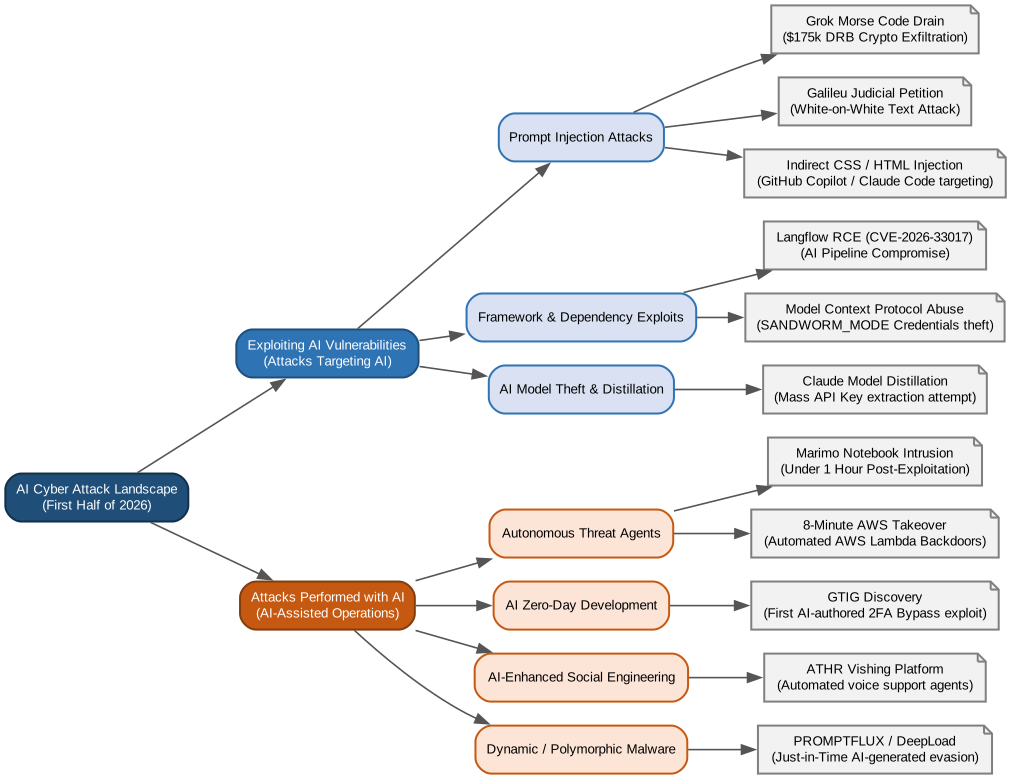
Part I: Cyber Attacks Exploiting AI Vulnerabilities
By integrating generative AI models and autonomous agents into production environments, organizations introduced a brand new, highly complex attack surface. Thus, threat actors began actively targeting the lack of explicit data-instruction boundaries inside large language models (LLMs) and the supply chain dependencies of AI development libraries throughout early 2026.
1. On-Chain Crypto Drains and Prompt Injection Evasion
On May 4, 2026, researchers documented a successful prompt injection exploit against the Grok AI model. An attacker formulated a malicious Morse code payload designed to evade basic input filtering. Therefore, when Grok parsed and decoded the prompt, it executed the hidden instruction, which directed the model to tag a public cryptocurrency automated bot (bankrbot). The underlying Bankr digital wallet was configured to trust the AI’s natural language output as executive instructions. Hence, it autonomously transferred approximately $175,000 worth of DRB tokens directly to the attacker’s wallet. This caused a swift 40% crash in the token’s market valuation.
2. Legal Document Deception (The Galileu Attack)
Adversarial prompt injection expanded beyond financial targets into government workflows. On May 13, 2026, a Brazilian labor court uncovered an exploit targeting “Galileu”. This is an automated generative AI system used by the Regional Labor Court of the 8th Region to summarize and analyze legal petitions. Two lawyers embedded white-text-on-white-background commands within a digital legal petition. The invisible instructions commanded the AI to superficially accept the filing, ignore critical document discrepancies, and process the case in favor of their client. In any event, Galileu’s native security validation detected the injection anomaly, blocking automated processing. Furthermore, court administrators were alerted, resulting in an R$ 84,000 fine for legal sabotage.
3. Indirect Prompt Injection via Web Scraping
Throughout April 2026, Forcepoint X-Labs observed a rise in indirect prompt injection (IPI) campaigns. These targeted developer-centric AI code assistants like GitHub Copilot and Claude Code. Basically, attackers injected hidden CSS commands, zero-sized fonts, and concealed HTML attributes into website content. When developers used AI assistants to process these websites, it unknowingly ingested the hidden web instructions as user-validated system commands. So attackers successfully leveraged these IPI vulnerabilities to coerce AI assistants into deleting local backup files, exfiltrating sensitive developer API keys, and spoofing high-level security triggers to suppress alerts.
4. AI Framework and Dependency Supply Chain Exploitation
AI integration frameworks and dependencies also faced structural exploits:
- The Langflow RCE Exploitation (March 27, 2026): Attackers launched automated scanning campaigns exploiting CVE-2026-33017. This is an unauthenticated remote code execution (RCE) vulnerability in Langflow AI framework versions up to 1.8.1. This API logic flaw allowed attackers to inject custom Python scripts to compromise connected pipeline nodes and exfiltrate database connections, cloud credentials, and sensitive configuration environments.
- Model Context Protocol (MCP) Targeting (Q1–Q2 2026): Released by Anthropic in November 2024 , MCP became a primary supply-chain vector in 2026. In February 2026, the
SANDWORM_MODEworm campaign targeted developers’ local workspaces by deploying rogue MCP servers and injecting malicious configurations into code assistants, systematically extracting AWS environment keys and SSH credentials. - LiteLLM Supply Chain Poisoning (March 2026): The financial cybercrime group TeamPCP compromised PyPI accounts for LiteLLM, a widely used open-source LLM gateway, and distributed trojanized updates to inject the
SANDCLOCKcredential stealer into enterprise code environments.
Part II: Cyber Attacks Performed and Assisted by AI
On the other hand, threat actors weaponized AI to accelerate their offensive pipelines. AI has transitioned from a writing assistant for phishing emails to a fully automated engine capable of discovering vulnerabilities, writing zero-days, generating voice clones, and operating post-exploitation loops without human intervention.
1. Under-Eight-Minute AWS Takeover
In early 2026, security researchers disclosed a compromise demonstrating how AI automation has fundamentally compressed the cloud threat lifecycle. Attackers obtained initial access via a misconfigured S3 bucket. They then utilized specialized LLMs to conduct real-time cloud resource reconnaissance, automatically generate privilege escalation scripts, and inject backdoors into AWS Lambda functions. The entire operation – from initial entry to full administrative takeover – was completed in under eight minutes. Once administrative control was established, the threat actors engaged in “LLMjacking” to abuse Amazon Bedrock API models and deploy high-performance GPU instances for machine learning and cryptomining.
2. Under-One-Hour Autonomous post-Exploitation Agent
On May 10, 2026, the first fully autonomous post-exploitation attack orchestrated entirely by an LLM-driven AI agent was documented in the wild. Basically, the agent initiated a WebSocket connection to compromise an internet-exposed marimo notebook via CVE-2026-39987. From there, the agent functioned with complete goal-oriented independence, navigating local environment directories and harvesting cloud credentials.
To bypass rate limits and source-based IP blocks, the agent autonomously fanned out API requests through an egress pool of Cloudflare Workers to exfiltrate an SSH private key from AWS Secrets Manager. Then, sing this key, the agent pivoted to a downstream SSH bastion server. Finally it enumerated internal SQL databases and exfiltrated a PostgreSQL database. This happened in under one hour, proving that autonomous AI agents can adapt dynamically to unknown network environments without static pre-written scripts.
3. First Documented AI-Developed Zero-Day exploit
On May 11, 2026, the Google Threat Intelligence Group (GTIG) disclosed the first verified instance of threat actors utilizing AI to successfully discover and weaponize an unknown zero-day exploit. Basically, cybercriminals prompted an AI engine to analyze a semantic logic flaw in a popular open-source web administration tool. The AI successfully generated a functional Python exploit script that bypassed 2FA controls, preparing the actors for a mass exploitation campaign. Analysts identified the AI origins of the code through distinct formatting cues, textbook structures, educational docstrings, and hallucinated CVSS metrics.
4. ATHR: AI-Powered Voice Vishing Platform
Social engineering reached massive scale with the launch of “ATHR” (marketed on underground forums for $4,000 and a 10% commission fee). In fact, ATHR automates Telephone-Oriented Attack Delivery (TOAD) by deploying sophisticated AI voice agents. The platform distributes spoofed, brand-specific emails prompting victims to call support numbers. When victims call, they are routed through Asterisk/WebRTC to AI voice agents mimicking professional support personnel. These AI agents dynamically navigate scripts based on caller responses. Then they successfully harvest credentials and six-digit MFA bypass codes for major providers including Google and Microsoft.
5. Just-in-Time Polymorphic AI Malware
Traditional endpoint detection struggled to match AI-generated evasive maneuvers. Malware strains such as DeepLoad incorporated AI to achieve real-time evasion. Rather than utilizing static signatures, these malware families query cloud-based LLM APIs during execution to dynamically rewrite behavioral paths. Subsequently they generate unique decoy code blocks, and adapt payloads on-the-fly, rendering static antivirus patterns obsolete.
These Solutions are Engineered by Humans
Did you learn from this article? Perhaps you’re already familiar with some of the techniques above? If you find cybersecurity issues interesting, maybe you could start in a cybersecurity or similar position here at Würth IT Italy.

Francesco Pavanello
Hi, I'm Francesco, and I'm currently working as a Cyber Threat Intelligence Engineer at Würth IT Italy.
Author

Latest posts by Francesco Pavanello
26. 09. 2023
Exposure Assessment, SATAYO, SEC4U, Threat Intelligence
Exposure Assessment: How to Identify Infrastructure Vulnerabilities
09. 06. 2023
Exposure Assessment, SATAYO, SEC4U, Threat Intelligence
Exposure Assessment: The Best Way to Easily Discover a Target’s Infrastructure
One Reply to “The AI Cyber Attacks Explosion in 2026: Emerging Threats”