
30. 09. 2026
Atlassian, Service Management

01. 07. 2026
Fabrizio Dovesi
AI, Atlassian, Service Management
A Hybrid IT Operating Model: PMBOK® Guide (Eighth Edition), ITIL® , and Agile Working Together
One practical approach to how the IT function of a global enterprise can govern strategy, manage digital products and services, and deliver work continuously, using a coherent three-layer model based on a hybrid operating model.
Building on What We Already Know
Running IT in a global enterprise is not a single problem. It is at least three problems happening simultaneously: deciding where to invest, keeping existing IT products and services running, and shipping work and value continuously. Most organizations pick one body of knowledge or framework and try to stretch it across all three. The result is predictable: either teams drown in governance overhead, or strategic decisions float free of any real discipline.
In my previous article on this blog, we explored how global IT organizations can scale Agile effectively, and concluded that there is no universally superior scaling framework. The best result typically comes from a deliberately designed hybrid operating model, one that selects and combines practices based on organizational context rather than framework loyalty.
This article takes that conclusion one step further. In IT, working and scaling Agile well at the execution layer is necessary, but not sufficient. A global enterprise also needs to govern strategic investments and manage running IT products and services with discipline. That requires bringing two more actors onto the stage: PMI’s PMBOK® Guide (Eighth Edition) at the strategic layer, and ITIL® at the operational layer.
Three Layers, One IT Operating Model
No single standard or framework covers every aspect of enterprise IT management at equal “altitude”. Those that attempt full coverage tend to be expensive and prescriptive, assuming a degree of “organizational greenfield” that most large enterprises simply do not have. Real enterprise IT organizations already operate complex, layered landscapes: established tools, vendor contracts, compliance obligations, and embedded team practices that cannot and should not be replaced wholesale.
The question is never “which single framework governs everything?” but rather “which standard, framework, methodology owns which decision, at which altitude?”
The Standard for Project Management wasn’t built to manage daily incident queues. ITIL wasn’t designed to govern a multi-million program portfolio. The Scrum framework wasn’t conceived to set investment priorities, define portfolio budgets, or articulate a multi-year technology strategy. Each element operates at a different depth and with different perimeters; together, they can be complementary by design, and they map naturally to three distinct layers.
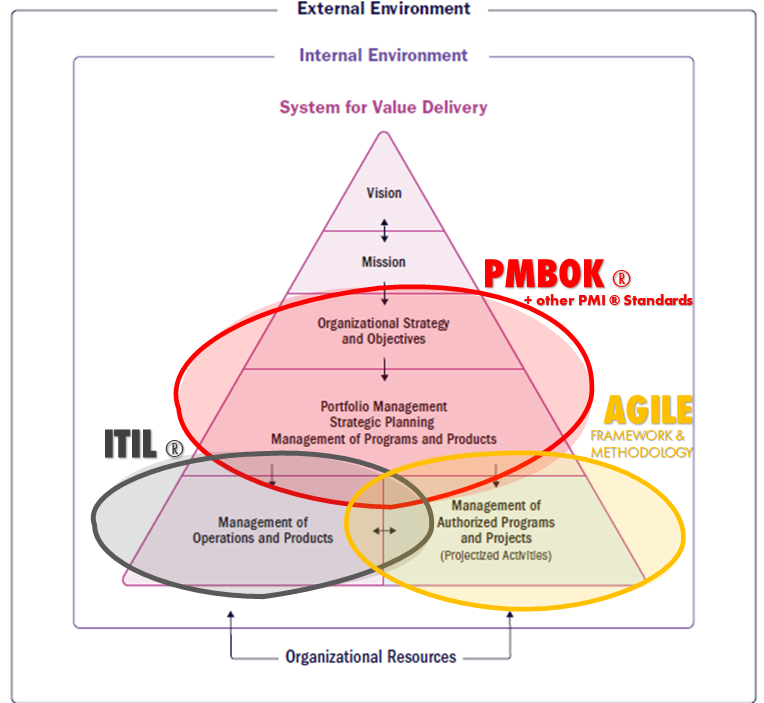
Layers do not operate in isolation; the interfaces connecting them are a structural requirement, not a design choice. So, ignoring them is not an option. Agile team data (cycle time, deployment frequency, defect rate) should feed the ITIL® Continual Improvement practice, which in turn informs portfolio reassessments at the strategic layer. Without it, governance becomes a one-way broadcast.
What Each Layer Owns
| Layer | Standard / Framework / Methodology | Primary Focus | Key Artifacts |
|---|---|---|---|
| Strategic | PMBOK® Guide — 8th Ed. | Portfolio governance, program alignment, project delivery, value & benefits | Business case, benefits register, project charter, risk register, stakeholder register |
| Operational | ITIL (Version 5) | Digital product & service lifecycle, AI-enabled operations, continual improvement | ITIL Value System, Product & Service Lifecycle model, Change Enablement records, SLA reports |
| Execution | Scrum / Kanban (Scrum Alliance) | Sprint-based project delivery, continuous operational flow, BAU improvement | Sprint backlog, increment, Kanban board, retrospective actions |
How Each Layer Contributes
The PMBOK® Guide, Eighth Edition (released in 2025) is precise in its architecture: PMI® publishes both The Standard for Project Management (normative, principle-based) and A Guide to the Project Management Body of Knowledge (descriptive, process-oriented) as a single unified publication. Moreover, other PMI standards are available to complete strategic level governance. For the CIO and PMO, three things directly matter:
- Six principles: Focus on Value, Adopt a Holistic View, Integrate Sustainability, Be an Accountable Leader, Build an Empowered Culture, and Embed Quality Into Processes and Deliverables apply at the portfolio, program, and project level equally.
- Seven performance domains with 40 embedded processes: Governance, Scope, Schedule, Cost, Quality, Resource, and Risk. The Governance domain is the explicit home for portfolio and program oversight.
- Artificial Intelligence-Appendix X3: AI-related initiatives can now be governed within the same principled standard as any other strategic investment.
ITIL (Version 5) (launched in February 2026) is now officially described as guidance for digital product and service management, a meaningful structural shift from ITIL 4. The framework explicitly positions itself in relation to the current era. Jjust as ITIL 4 referenced the Fourth Industrial Revolution, ITIL (Version 5) references Industry 5.0 as its broader context. The three most relevant changes/effects caused by this shift directly affecting the described hybrid model are:
- The ITIL 4 Service Value Chain is replaced by the Product and Service Lifecycle, unifying digital product management and service delivery into a single lifecycle model.
- The Service Value System is renamed the ITIL Value System, retaining the seven guiding principles (Focus on value, Start where you are, Progress iteratively with feedback, Collaborate and promote visibility, Think and work holistically, Keep it simple and practical, and Optimize and automate).
- ITIL AI Governance is now a dedicated publication and certification track, introducing the ITIL AI Capability Model (six capabilities: creation, curation, clarification, cognition, communication, and coordination), making AI governance a native dimension of operational management.
The 34 ITIL 4 management practices are retained by name, reorganized into Product and Service Management Practices and General Management Practices. Incident Management, Change Enablement, Problem Management, and Release Management remain the operational backbone, now explicitly bridging Agile and DevOps delivery within a product lifecycle model.
Scrum and Kanban, as defined, power the execution layer. Scrum enables teams to deliver value in fixed sprints with defined roles (Scrum Master, Product Owner, Development Team) and built-in retrospection. Kanban visualizes workflow, introduces the concept of “work in progress limit”, and optimizes continuous flow and delivery, particularly suited to operational queues where demand arrives unpredictably.
The Scrum Alliance recognizes these as complementary: Scrum for initiatives with defined goals and time-boxed increments; Kanban for continuous operational and BAU flows.
Scrum and Kanban are the most widely adopted expressions of Agile at the execution layer, but they are not the only ones. The Agile umbrella covers a broad range of frameworks, methods, and practices, and the spirit of the execution layer is precisely to preserve that breadth. Teams and working groups should be given the freedom to operate with the approach that best fits their context, their domain, and their way of working.
Imposing a single execution method from above risks creating exactly the kind of friction and slowdown that the execution layer exists to avoid. A bottom-up orientation, where teams shape their own ways of working within the guardrails set by the operational and strategic layers, is what keeps delivery fast, adaptive, and continuously oriented toward value.
The Integration Points That Make It Work
The “three most important” integration points define whether the model works or remains theoretical are:
Shared measurement as the binding language: The PMBOK® Guide tracks value and benefits; ITIL (Version 5) tracks service health and continual improvement outcomes; Scrum teams track velocity and sprint goals. Without a shared measurement layer cascading from portfolio to team level, these numbers never inform each other. That’s a governance design choice, not a tooling problem.
Single demand intake at the operational layer: Agile teams should not receive unfiltered demand from multiple sources. ITIL (Version 5) service request management and the Product and Service Lifecycle model act as the demand filter between strategy and execution.
Change Enablement as the structural handshake: Every sprint or release touching production infrastructure must pass through ITIL’s Change Enablement practice (not as a gate, but as the mechanism that prevents delivery speed from creating operational instability).
Conclusion
Global enterprise IT organizations don’t fail because they lack standards or frameworks. They fail because they apply them at the wrong altitude. The Standard for Project Management and the PMBOK® Guide (Eighth Edition) belong at the top. ITIL (Version 5), now explicitly oriented toward digital product and service management, AI governance, and continual improvement, belongs in the middle. Scrum and Kanban, as championed by the Scrum Alliance, belong at the base.
As we concluded in our previous article on scaling Agile: there is no universally superior approach. What matters is deliberate design: knowing which body of knowledge owns which decision, at which altitude, and ensuring the integration points between layers are governed, not assumed.
A standard or a framework without a well designed execution is just “documentation”. Execution without a standard or a framework behind is just “randomic activity”. The hybrid model is what turns both into value.
These Solutions are Engineered by Humans
Did you find this article interesting? Does it match your skill set? Our customers often present us with problems that need customized solutions. In fact, we’re currently hiring for roles just like this and others here at Würth IT Italy.
Author

Latest posts by Fabrizio Dovesi
30. 09. 2026
Atlassian, Service Management
Jira Formula Fields: A Long-Awaited Native Calculation Tool
31. 03. 2026
AI, Atlassian, Service Management
When Agile at Scale Meets Atlassian: Choosing the Right Scaling Model for Global IT Organizations
30. 12. 2025
AI, Atlassian, Service Management
Atlassian Rovo Today: Architecture, Technologies, and Enterprise Trust
01. 10. 2025
Atlassian, Service Management
Project Managers Are rAIsing the Bar: Redefining the Rules of the AI Game
30. 06. 2025
Atlassian, Service Management
Where ITIL® 4 Meets Atlassian: Elevating IT Service Management