30. 06. 2026
Azure, Cloud, Microsoft, NetEye, NetEye Extension Packs, Unified Monitoring

14. 02. 2017
Juergen Vigna
NetEye
Monitoring-Benachrichtigungen über Telegram oder Microsoft Teams versenden
Üblicherweise werden auftretende Probleme mittels E-Mail oder SMS an die zuständigen IT-Mitarbeiter gemeldet. Aber sind das tatsächlich schon alle möglichen Kanäle um Benachrichtigungen zu versenden?
Natürlich nicht. Zwei sehr geschickte Beispiele sind diese hier:
- Benachrichtigungen über die Telegram App (CLI)
- Benachrichtigungen über die Office 365 Web API (Microsoft Teams)
Telegram
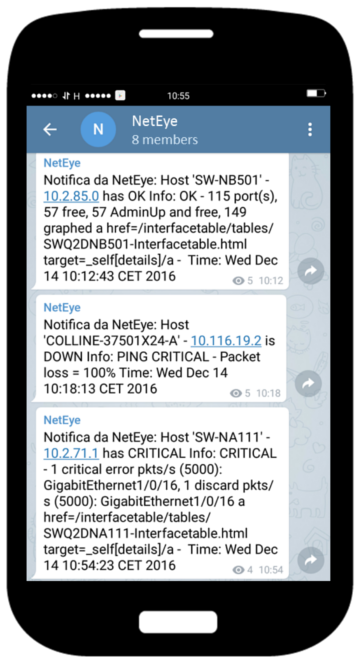
Wie Sie wahrscheinlich wissen, ermöglicht die WhatsApp-ähnliche App “Telegram” das Versenden von Nachrichten an Kontakte, Gruppen und Channels. Im Gegensatz zu WhatsApp stellt Telegram eine installierbares Command Line Interface bereit, durch welches Sie das Versenden von Nachrichten vom Computer aus skripten können. Sie müssen dazu die Telegram Binaries herunterladen und auf Ihrem Monitoring Server installieren. Anschließend definieren Sie den Benachrichtigungsbefehl im Monitoring folgendermaßen:
Host Notification: telegram-cli -W -e "msg $CONTACTEMAI$ Host '$HOSTNAME$' is $HOSTSTATE$ - Info: $HOSTOUTPUT$ - Time: $SHORTDATETIME$"
Service Notification: telegram-cli -W -e "msg $CONTACTEMAIL$ NetEye - $NOTIFICATIONTYPE$ - $SERVICEDESC$ - $HOSTNAME$ - $HOSTADDRESS$ - $SERVICESTATE$ - $SHORTDATETIME$ - $SERVICEOUTPUT$"
Natürlich sollten Sie vorher Ihren Monitoring-Host als Telegram-Sender registrieren (wie Sie es auch auf Ihrem Smartphone tun würden). Hierfür können Sie die selbe Telefonnummer verwenden wie für den SMS-Versand.
Office 365
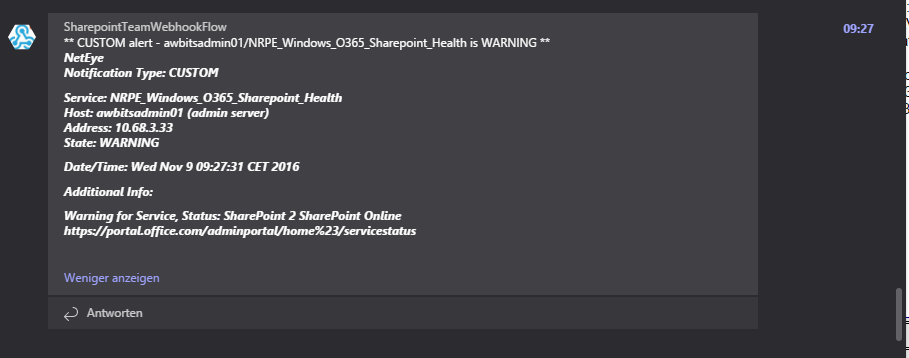
Hier haben Sie die Möglichkeit Gruppen zu registrieren. Für die Benachrichtigung benötigen Sie genau diese GUID, danach können Sie diesen Befehl nutzen um die Benachrichtigungen zu versenden:
Host Notification: curl -H "Content-Type: application/json" -d "{\"title\": \"** $NOTIFICATIONTYPE$ alert - $HOSTNAME$ is $HOSTSTATE$ **\", \"text\": \"***** NetEye *****\n\nNotification Type: $NOTIFICATIONTYPE$\nHost: $HOSTNAME$\nState: $HOSTSTATE$\nAddress: $HOSTADDRESS$\nInfo: $HOSTOUTPUT$\n\nDate/Time: $LONGDATETIME$\n\", \"themeColor\": \"EA4300\"}" https://outlook.office365.com/webhook/YOURGUIDHERE
Service Notification: curl -H "Content-Type: application/json" -d "{\"title\": \" ** $NOTIFICATIONTYPE$ alert - $HOSTNAME$/$SERVICEDESC$ is $SERVICESTATE$ **\", \"text\": \"***** NetEye *****\n\nNotification Type: $NOTIFICATIONTYPE$\n\nService: $SERVICEDESC$\n[HealthPortalURL]($SERVICENOTESURL$)\nHost: $HOSTNAME$ ($HOSTALIAS$)\nAddress: $HOSTADDRESS$\nState: $SERVICESTATE$\n\nDate/Time: $LONGDATETIME$\n\nAdditional Info:\n\n$SERVICEOUTPUT$\", \"themeColor\": \"EA4300\"}" https://outlook.office365.com/webhook/YOURGUIDHERE
Ich hoffe diese zwei Ideen helfen Ihnen dabei Ihre Monitoring-Benachrichtigungen auszubauen.

Juergen Vigna
NetEye Solution Architect at Würth IT Italy
I have over 20 years of experience in the IT branch. After first experiences in the field of software development for public transport companies, I finally decided to join the young and growing team of Würth Phoenix (now Würth IT Italy). Initially, I was responsible for the internal Linux/Unix infrastructure and the management of CVS software. Afterwards, my main challenge was to establish the meanwhile well-known IT System Management Solution WÜRTHPHOENIX NetEye. As a Product Manager I started building NetEye from scratch, analyzing existing open source models, extending and finally joining them into one single powerful solution. After that, my job turned into a passion: Constant developments, customer installations and support became a matter of personal. Today I use my knowledge as a NetEye Senior Consultant as well as NetEye Solution Architect at Würth Phoenix.
Author

Latest posts by Juergen Vigna
22. 05. 2025
NetEye, Unified Monitoring
Automatic Integration of NagVis Map into Icinga Web 2/NetEye Monitoring