30. 06. 2026
Azure, Cloud, Microsoft, NetEye, NetEye Extension Packs, Unified Monitoring

21. 09. 2012
Juergen Vigna
Business Process, Nagios, NetEye
Notifications on critical business elements
The Business Services monitoring module of NetEye has been designed to obtain a higher abstraction level to define IT Services. It allows to configure the dependencies of the IT services with the infrastructure components. In this way it is also possible to simulate the business impact that for instance a server anomaly will have on the service level generating accurate reports on the availability of the business processes (often needed for the Service Level Agreements).
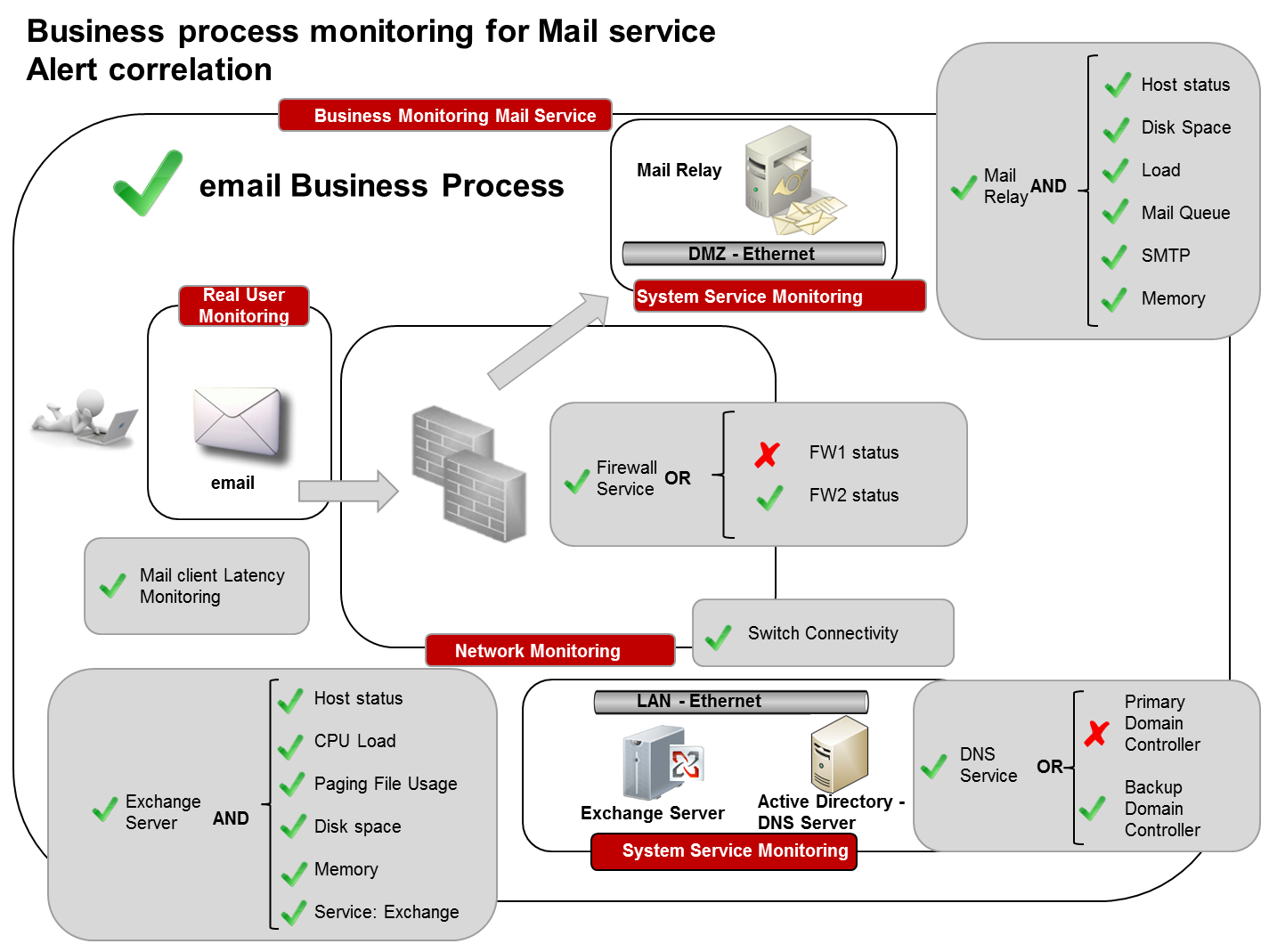
I have recently developed a new enhancement for this module to facilitate the identification of the business element that is causing a certain anomaly by inserting the corresponding information directly in the notification message. Till now in case of notification of critical business services, in fact it was not possible to identify immediately the business element that was originating the alarm, but it was necessary to navigate through the business services to detect the cause.
What has been recently done is that if the business services are grouped in a business group (setting that can be performed in the Business service configuration module) than in the notification message for critical situations it will be visualized not only the business service in status critical but also the related business elements that are causing the inefficiency.
In this way you can easily and quickly determine the source of the criticality and find a proper solution by analyzing the correct business element.
This new feature will be available in the next minor of NetEye (versione 3.4).

Juergen Vigna
NetEye Solution Architect at Würth IT Italy
I have over 20 years of experience in the IT branch. After first experiences in the field of software development for public transport companies, I finally decided to join the young and growing team of Würth Phoenix (now Würth IT Italy). Initially, I was responsible for the internal Linux/Unix infrastructure and the management of CVS software. Afterwards, my main challenge was to establish the meanwhile well-known IT System Management Solution WÜRTHPHOENIX NetEye. As a Product Manager I started building NetEye from scratch, analyzing existing open source models, extending and finally joining them into one single powerful solution. After that, my job turned into a passion: Constant developments, customer installations and support became a matter of personal. Today I use my knowledge as a NetEye Senior Consultant as well as NetEye Solution Architect at Würth Phoenix.
Author

Latest posts by Juergen Vigna
22. 05. 2025
NetEye, Unified Monitoring
Automatic Integration of NagVis Map into Icinga Web 2/NetEye Monitoring