30. 09. 2026
Atlassian, Service Management

23. 06. 2026
Giuseppe Di Garbo
Atlassian
Customer Feedback in Jira Service Management: CSAT and Native Surveys Explained
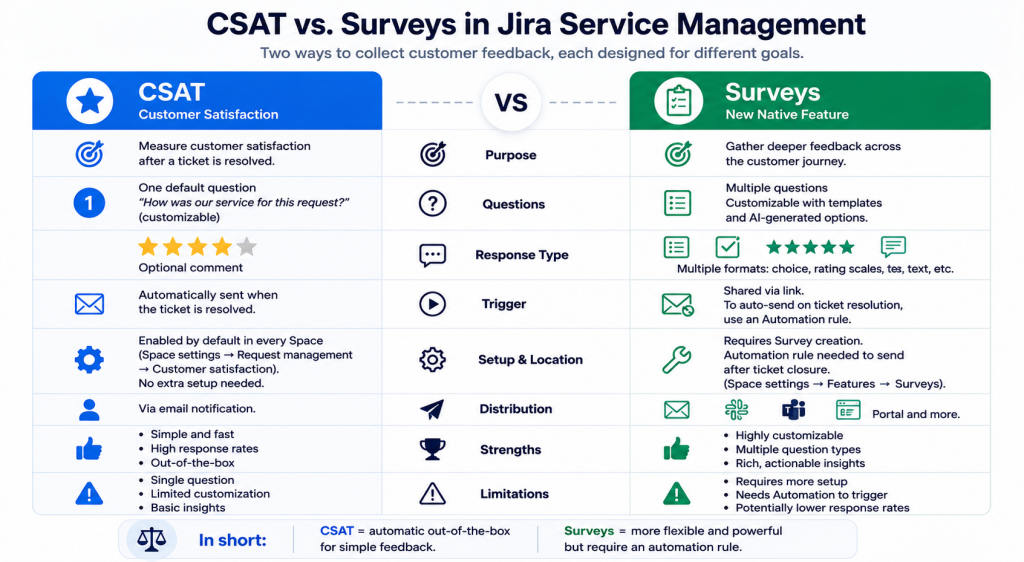
Customer feedback provides insights that operational metrics alone cannot capture. Jira Service Management has long offered built-in CSAT surveys, automatically collecting satisfaction ratings through a simple star-based mechanism when tickets are resolved.
With the introduction of Native surveys, Atlassian extends these capabilities with a more flexible survey builder supporting multiple questions and richer feedback. While CSAT works out of the box and requires no additional setup, Surveys are link-based and typically rely on Automation rules to be sent after ticket closure.
In essence, CSAT delivers immediate and lightweight feedback, whereas Surveys provide greater flexibility and deeper insights through more advanced questionnaires.
Customer Feedback in Service Management
Why Feedback Matters
Service management is not limited to meeting operational targets. Customers ultimately evaluate the quality of a service based on their experience, communication, responsiveness and the perceived effectiveness of the solution.
Feedback mechanisms help organizations:
- Measure customer satisfaction over time
- Identify trends and recurring pain points
- Detect opportunities for process improvement
- Validate the impact of service changes
- Strengthen relationships with customers and stakeholders
While traditional CSAT surveys focus on immediate satisfaction after issue resolution, broader survey capabilities enable organizations to gather strategic insights beyond single support interactions.
CSAT in Jira Service Management
Understanding the Native CSAT Feature
Customer Satisfaction (CSAT) has been available in Jira Service Management for several years and provides a lightweight mechanism to measure customer sentiment after a request reaches a completed state.
When a ticket is resolved, customers receive an email containing a simple rating system represented by stars. This approach minimizes friction and encourages higher participation rates.
CSAT is enabled by default in every Space through Space settings → Request management → Customer satisfaction and requires no additional configuration. The default question, “How was our service for this request?”, can be customized if needed.
Star Ratings and Customer Experience
The rating system is intentionally straightforward. Users can quickly express their level of satisfaction without requiring additional effort.
The customer experience includes:
- Star-based ratings directly embedded in notification emails
- Optional comments accompanying the rating
- Visibility of collected feedback inside Jira Service Management
- Historical tracking of customer satisfaction metrics
- Reporting capabilities to monitor trends over time
Because of its simplicity, CSAT delivers a high response rate and provides an immediate pulse on service quality.
Strengths of CSAT
The native CSAT mechanism offers several advantages:
- Extremely simple user experience
- Minimal configuration effort
- High response rates due to low interaction overhead
- Direct integration with request workflows
- Useful trend analysis for support teams
Limitations of CSAT
Despite its effectiveness, CSAT is intentionally narrow in scope.
Some limitations include:
- Single-purpose feedback focused on ticket resolution
- Limited question customization
- Lack of conditional logic
- Inability to collect complex or structured information
- Reduced flexibility for broader customer experience initiatives
Native Surveys in Jira Service Management
Understanding the New Surveys Capability
Unlike CSAT, Native Surveys are a separate capability within Jira Service Management rather than an evolution of the traditional customer satisfaction mechanism.
Survey configuration is available under:
Space settings → Features → Surveys
This distinction is important because CSAT and Surveys coexist and serve different purposes. Organizations can use both capabilities simultaneously depending on the type of feedback they want to collect.
Expanding Beyond Satisfaction Scores
The introduction of native Surveys significantly broadens Jira Service Management capabilities. Rather than limiting feedback to a star rating, organizations can design custom questionnaires tailored to specific objectives.
Surveys allow teams to gather insights related to onboarding experiences, change management initiatives, service improvements, knowledge base effectiveness or periodic customer assessments.
This transforms Jira Service Management from a reactive feedback platform into a more comprehensive experience management tool.
Survey Capabilities
Native Surveys provide a complete survey builder with support for multiple questions, templates and AI-assisted generation.
Unlike CSAT, surveys are distributed through links and are not automatically triggered when a request is resolved. To send a survey after ticket closure, an Automation rule must generate an email containing the survey link.
Native Surveys are built on the same Forms framework already used within Jira Service Management. This enables structured data collection while avoiding the need for external survey platforms and disconnected feedback repositories.
Custom Questions: Organizations can define multiple questions according to the type of information they want to collect.
Multiple Answer Formats: Different response types support various use cases, including:
- Single-choice questions
- Multiple-choice questions
- Rating scales
- Free-text responses
Flexible Distribution: Surveys can be associated with service requests and integrated into customer interactions more naturally than traditional CSAT ratings.
Richer Insights: Structured responses provide additional context that cannot be captured through star ratings, making it easier to identify improvement opportunities and understand customer expectations.
Atlassian is also exploring deeper integrations with Rovo AI to simplify sentiment analysis and accelerate follow-up activities based on survey responses.
Typical Use Cases
Survey capabilities support scenarios such as:
- Measuring onboarding experiences
- Evaluating service desk quality after major projects
- Gathering feedback on self-service portals and knowledge bases
- Assessing change management activities
- Running periodic customer experience initiatives
- Collecting structured information for continuous improvement programs
Best Practices for Feedback Collection
Keep Surveys Focused
Short surveys consistently achieve higher response rates. Customers are more willing to provide feedback when the effort required is limited.
Ask Actionable Questions
Questions should generate information that can lead to concrete improvements. Collecting data without a clear purpose often results in noise rather than insights.
Combine Quantitative and Qualitative Feedback
Ratings provide measurable trends, while open comments explain the reasons behind those scores. Both perspectives are necessary for complete understanding.
Review Trends Rather Than Isolated Responses
Individual responses may be influenced by specific circumstances. Long-term patterns offer a more reliable view of service quality.
Avoid Survey Fatigue
Requesting feedback too frequently can reduce participation and negatively impact customer experience. Feedback mechanisms should remain meaningful and non-intrusive.
Advantages and Drawbacks
CSAT advantages
- Simple and intuitive
- High participation rates
- Immediate measurement after ticket resolution
- Easy to configure and maintain
CSAT Drawbacks
- Limited flexibility
- Restricted to satisfaction measurement
- Minimal contextual information
Native Surveys advantages
- Greater customization
- Richer insights
- Support for multiple use cases
- More structured feedback collection
Native Surveys drawbacks
- Increased configuration effort
- Potentially lower response rates for longer questionnaires
- Requires careful design to avoid excessive complexity
When to Use Which
CSAT and Surveys are complementary rather than competing capabilities.
CSAT is ideal when the goal is to continuously monitor customer sentiment after support interactions. Its simplicity makes it particularly effective for service desks seeking fast and reliable indicators.
Native Surveys are better suited when organizations need deeper insights or want to evaluate specific processes, initiatives or customer experiences. They provide the flexibility required for more sophisticated feedback programs and support broader service improvement strategies.
In many environments, the most effective approach is to use both mechanisms together: CSAT for ongoing operational measurement and Surveys for targeted analysis and strategic initiatives.
References
- About customer satisfaction (CSAT) surveys
- Get started with surveys
- Introducing native surveys in Jira Service Management Cloud
These Solutions are Engineered by Humans
Did you find this article interesting? Does it match your skill set? Our customers often present us with problems that need customized solutions. In fact, we’re currently hiring for roles just like this and others here at Würth IT Italy.

Giuseppe Di Garbo
Consultant at Würth IT Italy
Hi everybody. I’m Giuseppe and I was born in Milan in 1979. Since the early years of university, I was attracted by the Open Source world and operating system GNU\Linux. After graduation I had the opportunity to participate in a project of a startup for the realization of an Internet Service Provider. Before joining Würth Phoenix (now Würth IT Italy) as SI consultant, I gained great experience as an IT consultant on projects related to business continuity and implementation of open source software compliant to ITIL processes of incident, change and service catalog management. My free time is completely dedicated to my wife and, as soon as possible, run away from Milan and his caotic time and trekking discover our beautiful mountain near Lecco for relax and lookup the (clean) sky.
Author

Latest posts by Giuseppe Di Garbo
30. 09. 2026
Atlassian
Workforce Management in Jira Service Management: From Ticket Assignment to Capacity Management
19. 12. 2025
Atlassian, Service Management
Jira Service Management Customer Detail Fields: A Practical Use Case
29. 09. 2025
Atlassian, Service Management
Streamlining Service Request Management with ITIL4 and Jira Service Management
30. 06. 2025
Atlassian, Service Management
Creating Jira Service Management Requests from a Public Website? Here’s the Secure, No-API Way