29. 09. 2026
AI, NetEye, Unified Monitoring

10. 12. 2021
Franco Federico
APM, NetEye, NetEye Extension Packs, Real User Experience, Visual Synthetic Monitoring
NEP Alyvix – Ready for Use
Together with the NetEye 4.21 release, we also released NEP (an abbreviation that stands for NetEye Extension Packs) and now it’s possible to install it using the RPM present in the Official NetEye Repositories.
If you are interested in this topic, I invite you to look at how these NEPs have been set up.
The authors of the NEPs are the NetEye consultants, although they are open to anyone who is interested in participating.
Here are some useful links:
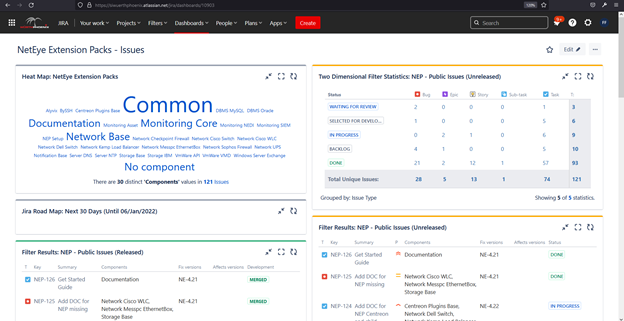
1) At this link you can find all the open issues and at what stage of development the new NEPs currently are:
https://siwuerthphoenix.atlassian.net/jira/dashboards/10903
Here’s a preview of this dashboard:
2) At this link you’ll find the source code on which the RPM is based:
https://bitbucket.org/siwuerthphoenix/nep/src/master/
You can create your own NEP and send a pull request to the people who manage the repo.
As the title of this blog says, I developed this NEP as a result of writing the following two blogs:
- https://www.neteye-blog.com/2021/11/how-tos-for-alyvix-server-integration-into-neteye-4/
- https://www.neteye-blog.com/2020/12/integrating-alyvix-3-into-neteye-4/
This NEP allows you to monitor the Alyvix Server service (which is called Alyvix Service on Windows) that manages the scheduling of test cases, and then to monitor the individual test cases after configuring them correctly in a NetEye service set.
For more information, you can refer to the guide that was written in RUST to be inserted directly into the official NetEye guide:
https://neteye.guide/4.21/doc/nep-alyvix/nep-alyvix.html
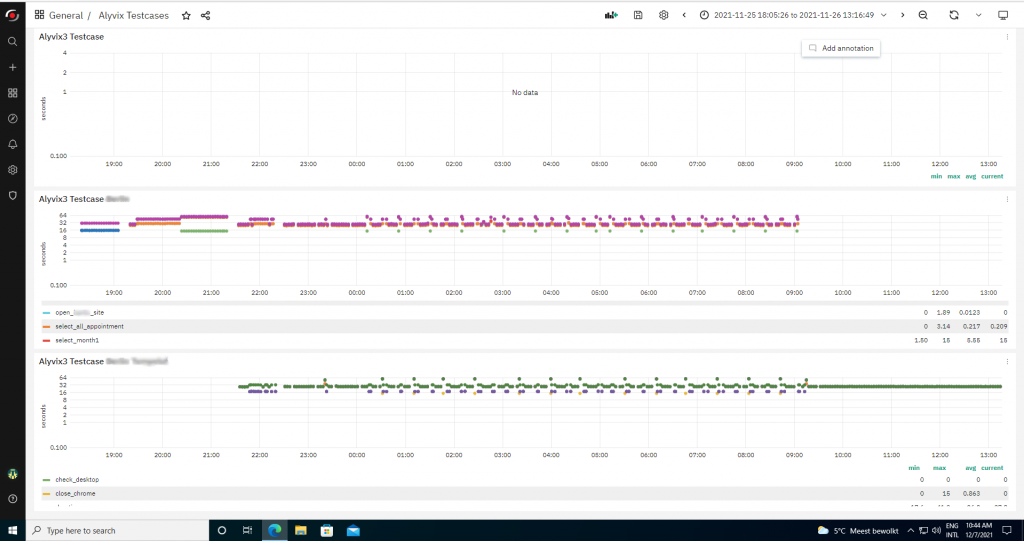
This NEP allows you to prepare the integration with Alyvix Server and have the collection of metrics in a special dashboard.
So after creating a test case, just take it and add it to the appropriate service set (nx-ss-alyvix3-restapi). The dashboard called Alyvix Testcase is already ready and lets you find out how the scheduled test cases are going.
Currently the packages available in addition to the Alyvix package are the following:
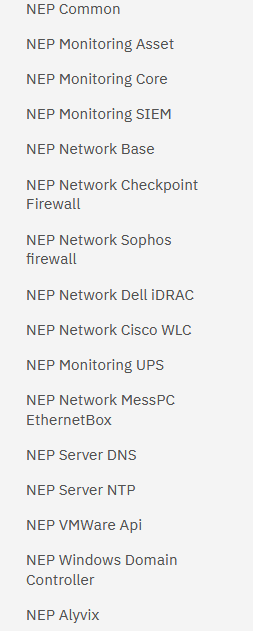
and can be found at this link:
https://neteye.guide/4.21/doc/nep-available-packages.html
I hope that the community grows and that many more NEPs can be added as well.
Enjoy the NetEye Extension Packs!

Franco Federico
Hi, I’m Franco and I was born in Monza. For 20 years I worked for IBM in various roles. I started as a customer service representative (help desk operator), then I was promoted to Windows expert. In 2004 I changed again and was promoted to consultant, business analyst, then Java developer, and finally technical support and system integrator for Enterprise Content Management (FileNet). Several years ago I became fascinated by the Open Source world, the GNU\Linux operating system, and security in general. So for 4 years during my free time I studied security systems and computer networks in order to extend my knowledge. I came across several open source technologies including the Elastic stack (formerly ELK), and started to explore them and other similar ones like Grafana, Greylog, Snort, Grok, etc. I like to script in Python, too. Then I started to work in Würth Phoenix like consultant. Two years ago I moved with my family in Berlin to work for a startup in fintech(Nuri), but the startup went bankrupt due to insolvency. No problem, Berlin offered many other opportunities and I started working for Helios IT Service as an infrastructure monitoring expert with Icinga and Elastic, but after another year I preferred to return to Italy for various reasons that we can go into in person 🙂 In my free time I continue to dedicate myself to my family(especially my daughter) and I like walking, reading, dancing and making pizza for friends and relatives.
Author

Latest posts by Franco Federico
10. 06. 2026
Unified Monitoring
Transform Metrics into Alerts
10. 03. 2026
Unified Monitoring
Elastic AutoOps in NetEye: Simplifying Elasticsearch Operations with Real-Time Intelligence
09. 09. 2025
NetEye
Backing up a MariaDB Galera Cluster