
Azure DNS Private Resolver is a managed service that enables you to resolve DNS queries for private DNS zones across Azure and on-premises networks, simplifying hybrid network architectures and removing the need for custom DNS servers or DNS forwarders hosted on virtual machines. This service reduces operational complexity and provides scalable, secure name resolution for modern cloud environments.
Classic Architecture: Custom DNS in Azure
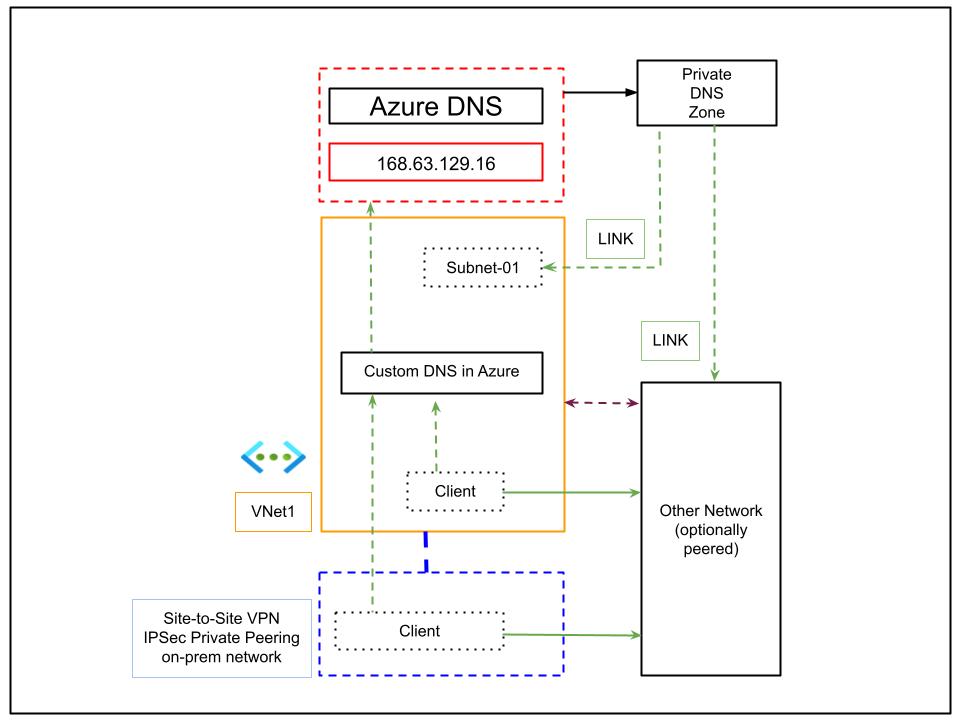
In the diagram above, an on-premises network connects to Azure via Site-to-Site VPN or ExpressRoute. DNS resolution is handled by a custom DNS instance deployed in Azure, which forwards queries for Azure Private DNS zones to the special Azure DNS address, 168.63.129.16. Clients on both on-premises and peered networks use this Azure-based DNS server for name resolution of Azure resources.
- This setup is simple but requires managing a custom DNS server in Azure
- The Azure DNS special IP is used for resolving resources registered in Private DNS zones
- Maintenance and operational overhead remain, since you are responsible for patching and availability of the DNS server
On-Premises DNS with Azure-based DNS Forwarder
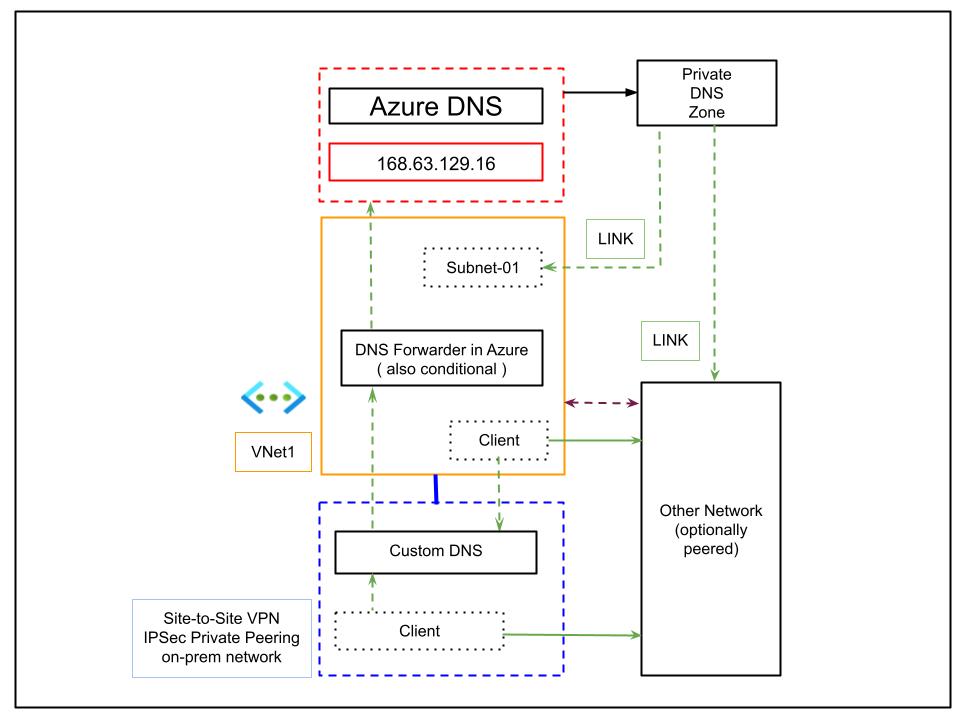
The second diagram is a close variation, replacing the custom DNS with a DNS Forwarder. The forwarder is deployed in Azure as a VM or domain controller. This means you can keep your main DNS infrastructure on-premises, while using an Azure-based forwarder to handle Azure-specific resolutions.
- Maintenance cost is similar to that in the first architecture
- The main advantage is consolidated management, as the core DNS remains in your data center
- Still, an Azure VM is required for forwarding, which adds some complexity
Streamlined Modern Architecture: Azure DNS Private Resolver
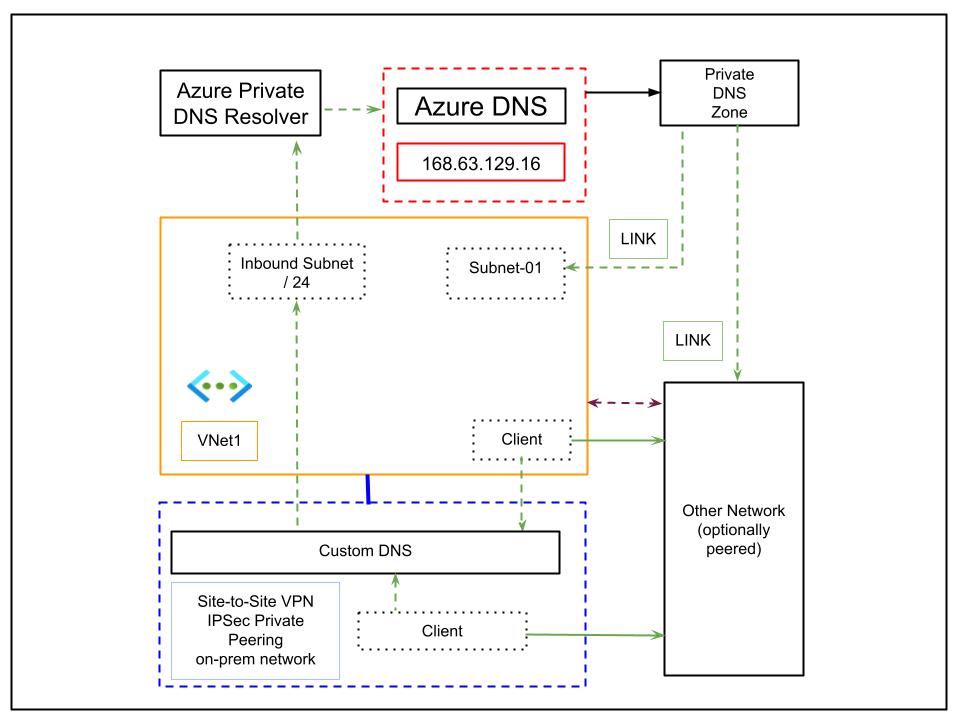
Deploying Azure DNS Private Resolver replaces the need for custom DNS or DNS forwarders running on VMs. It introduces an inbound endpoint deployed in a dedicated subnet (recommended size /24), enabling any network – on-premises or Azure – to resolve names registered in Azure Private DNS zones.
- No need for VM-based DNS servers, reducing complexity and operational cost
- Azure manages scaling, availability, and security
- The architecture is cleaner and easier to maintain since only the inbound endpoint is needed
- Make sure the subnet hosting the inbound endpoint is dedicated and properly delegated to the DNS resolver resource
Hybrid Name Resolution: Adding an Outbound Subnet and Forward Rule Set
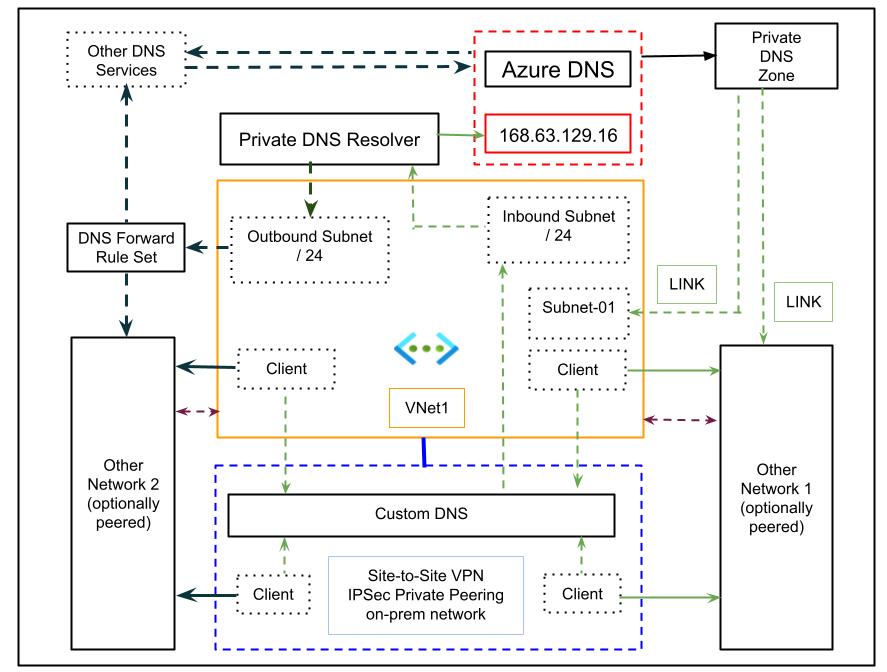
The final diagram builds on the simplified architecture by including an outbound endpoint and a forwarding rule set. This configuration lets Azure DNS Private Resolver forward queries for domains that reside outside Azure (such as other cloud providers or legacy environments) to external DNS services.
- The DNS Forwarding Rule Set lets you manage which queries are sent to which DNS targets, supporting advanced hybrid scenarios
- The outbound endpoint enables Azure resources to resolve non-Azure names when required
- Both inbound and outbound subnets should be dedicated, and recommended being sized /24 to provide sufficient scale
Architectural Guidance and Best Practices
You should:
- Prefer Azure DNS Private Resolver for native integration, scalability, and security within Azure; minimize reliance on VM-based DNS forwarders or custom DNS servers
- Use dedicated subnets (/24 preferred) for both inbound and outbound endpoints, and delegate them specifically to Microsoft.Network/dnsResolvers
- Link Private DNS Zones to the virtual networks that need to resolve those names
- For on-premises resolution, configure conditional forwarders on your DNS infrastructure to point to the inbound endpoint IP of Azure DNS Private Resolver
- Use forwarding rulesets to manage DNS resolution across hybrid and multi-cloud environments efficiently
Budgeting Considerations
Azure DNS Private Resolver uses a simple, transparent pricing model that often reduces total cost of ownership compared to running your own DNS servers or domain controllers on virtual machines. Azure charges per inbound endpoint, per outbound endpoint, and per ruleset, plus the standard zone and query charges for Azure DNS, with no extra cost for patching, scaling, or high availability of the resolver itself.
- https://docs.azure.cn/en-us/dns/private-resolver-hybrid-dns
- https://azure.microsoft.com/en-us/products/dns
- https://azure.microsoft.com/en-us/pricing/details/dns/
Microsoft’s documentation highlights that because the resolver is fully managed and multi-tenant, it typically runs at a fraction of the cost of traditional IaaS-based DNS solutions that require multiple VMs, operating system licenses, storage, backup, and lifecycle management.
In contrast, architectures based on custom DNS servers or domain controllers in Azure must account for the hourly VM cost, disks, backup, and any Windows Server or Active Directory licensing, and they still require operational processes for patching, monitoring, and troubleshooting.
When comparing options, Microsoft recommends using the Azure Pricing Calculator and the Azure DNS pricing page to model the resolver endpoints and rulesets versus the equivalent VM-based design. In many hybrid scenarios, especially where high availability or multiple regions are required, the Private Resolver provides a more predictable and often lower ongoing cost, while also simplifying management.
Cross-Regional Setup
Azure DNS Private Resolver is a regional service, meaning each resolver is deployed within a specific Azure region and provides DNS resolution endpoints only within that region.
However, it is possible to use Azure DNS Private Resolver for cross-region scenarios by deploying resolver instances in each region where DNS resolution is required, and then configuring your networking and DNS architecture appropriately.
- Deploy a Private DNS Resolver in each Azure region where you need local DNS resolution.
- Link your Azure Private DNS zones, which are globally replicated resources, to virtual networks in each relevant region. This allows VMs and services in any region to resolve DNS names from the shared zone, minimizing the need for DNS queries to cross regional boundaries.
- For hybrid and multi-region environments, conditional forwarders or failover can direct DNS queries to the nearest available resolver endpoint. On-premises or external DNS systems can be configured to forward requests to more than one resolver for redundancy.
- This approach ensures high availability and minimizes single-region dependencies, as recommended best practice is to avoid relying on DNS resolution from a remote region for production workloads.
https://docs.azure.cn/en-us/dns/tutorial-dns-private-resolver-failover
References
- https://azure.microsoft.com/en-us/pricing/details/dns/
- https://docs.azure.cn/en-us/dns/private-resolver-hybrid-dns
- https://learn.microsoft.com/en-us/azure/dns/dns-private-resolver-overview
- https://azure.microsoft.com/en-us/products/dns
- https://learn.microsoft.com/en-us/azure/architecture/networking/architecture/azure-dns-private-resolver
- https://petri.com/deploy-domain-controllers-azure-virtual-machines/
- https://allazureblog.wordpress.com/2025/03/04/simplifying-private-dns-in-azure-understanding-adds-and-dns-private-resolvers/
- https://azure.microsoft.com/en-us/pricing/calculator/
- https://azure.microsoft.com/it-it/pricing/details/dns/
- https://www.reddit.com/r/AZURE/comments/1ak25fe/dns_private_resolver_sooooo_expensive/
- https://www.azure.cn/en-us/pricing/details/dns/
- https://www.linkedin.com/posts/houssemdellai_dns-azure-activity-7164208137909043200-lDZW
- https://azurenavigator.com/understanding-azure-network-pricing/
- https://duo-infernale.ch/azure-dns-vs-dns-in-microsoft-365/
- https://www.reddit.com/r/AZURE/comments/wipzu5/azure_dns_private_resolver_pricing_issues/
- https://nri-na.com/blog/azure-active-directory-domain-services/
- https://azure.microsoft.com/en-us/pricing/details/defender-easm/
- https://www.applytosupply.digitalmarketplace.service.gov.uk/g-cloud/services/746432103223202
- https://jussiroine.com/2022/10/lessons-learned-testing-new-azure-features/
- https://faddom.com/azure-vms-pricing/
These Solutions are Engineered by Humans
Did you read this article because you’re knowledgeable about networking? Do you have the skills necessary to manage networks? We’re currently hiring for roles like this as well as other roles here at Würth IT Italy.

Davide Spano
Author
