
The new Shutdown Management tool, which is available since the release of NetEye 3.5 is used more and more.
With this tool, you are able to automatically start a structured shutdown procedure of your IT datacenter, in case a predefined threshold is exceeded.
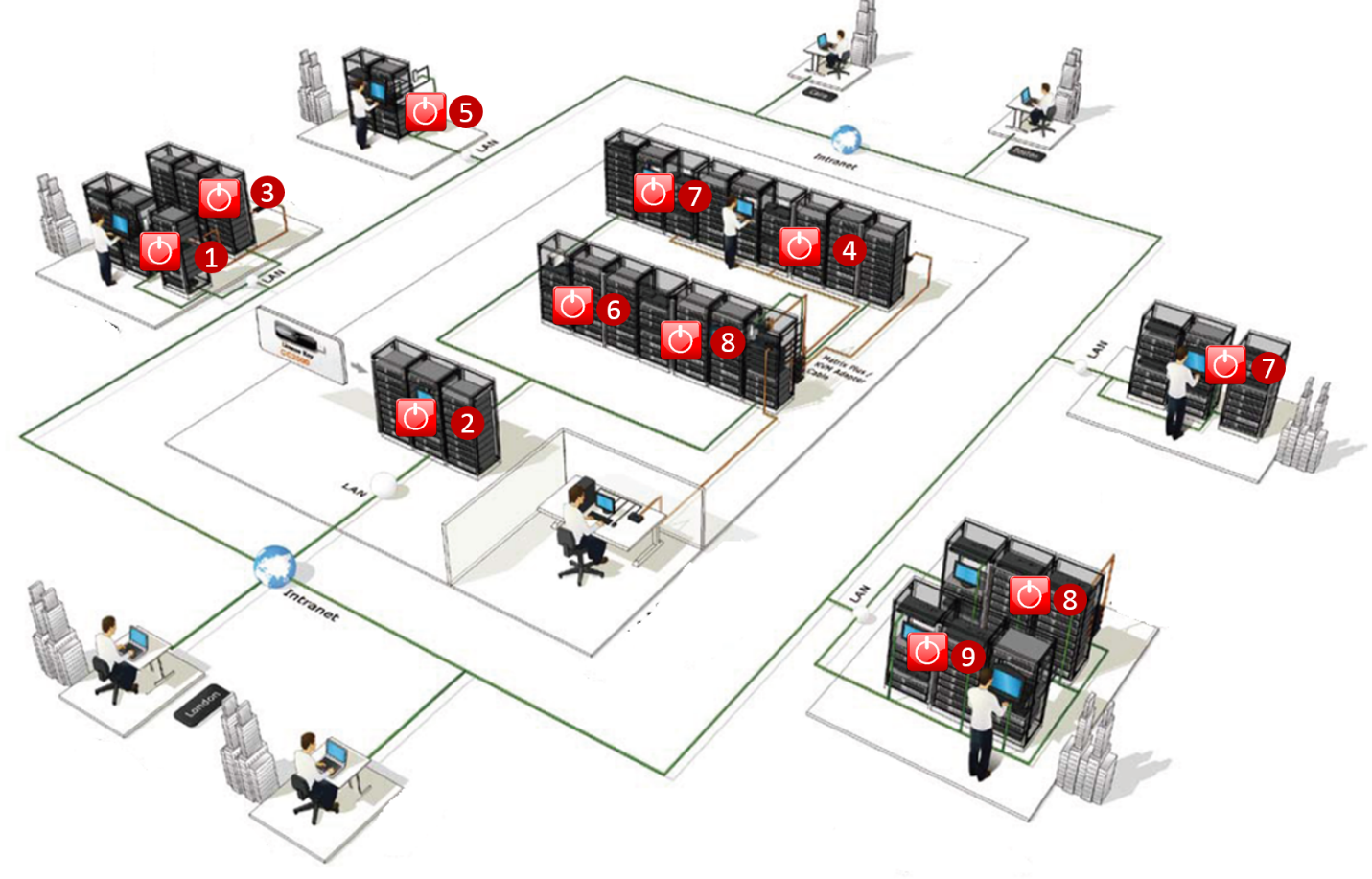
By using existing NetEye environmental controls, deriving from the smoke sensor or the temperature sensor in your datacenter, you are able to trigger a structured datacenter shutdown.
The Shutdown Management tool is able to interact with many systems for launching a shutdown. In this way, I shortly have implemented shutdown solutions, on which I had to power off Windows and Linux Systems. Furthermore, the Shutdown Management can shut down all the active virtual machines on a VMware ESX infrastructure and at the end shutdown also itself.
However, there are existing some more particular systems to shutdown, like storage systems or firewalls. In these cases, I have just used the different interfaces on the Shutdown Management tool for powering off EMC, IBM and HP storage systems and different firewalls.
In addition, the structured shutdown module offers you the possibility to decide the shutdown order and possible wait times in the shutdown sequence.
Very interesting is also the possibility to activate a shutdown button on the Shutdown Management tool for powering off the datacenter.
In this way, the presence of a system administrator for doing a structured infrastructure shutdown isn’t necessary anymore.



Tobias Goller
NetEye Solution Architect at Würth IT Italy
I started my professional career as a system administrator.
Over the years, my area of responsibility changed from administrative work to the architectural planning of systems.
During my activities at Würth IT Italy, the focus of my area of responsibility changed to the installation and consulting of the IT system management solution WÜRTHPHOENIX NetEye.
In the meantime, I take care of the implementation and planning of customer projects in the area of our unified monitoring solution.
Author

Latest posts by Tobias Goller
16. 02. 2026
Unified Monitoring
OpenShift Monitoring in NetEye
13. 10. 2025
Log-SIEM, Unified Monitoring
Elastic Defend: Experiences
18. 07. 2025
Automation, Cloud
Running SOS Berlin JobScheduler in Containers: A Step Toward Cloud-Native Scheduling
16. 04. 2025
NetEye, Unified Monitoring
Application Performance Monitoring in NetEye with Elastic APM and OpenTelemetry