


30. 12. 2025
Atlassian, Service Management

29. 09. 2025
Giuseppe Di Garbo
Atlassian, Service Management
Streamlining Service Request Management with ITIL4 and Jira Service Management
Introduction
In every IT team, service requests are the everyday heartbeat of operations. From resetting a password, granting access to a tool, setting up new equipment, or answering a simple “how do I?” question, these are routine, predictable tasks. But if handled poorly, they can quickly lead to frustration, inefficiency, and higher costs.
Service Request Management (SRM) exists to bring order and efficiency to this chaos. According to ITIL4, a service request is a request from a user, or their authorized representative, that initiates a service action that has been agreed as part of normal service delivery.
The main purpose of SRM is to ensure that all predefined, user-initiated requests are handled effectively and in a user-friendly way. This means requests are predictable, well-documented, and supported by clear steps and timelines. The ITIL4 framework also encourages automation and standardization, which help speed up fulfillment and reduce manual effort.
At the core of SRM is request fulfillment, the journey a request follows from submission through to completion, evaluation, and continuous improvement. A structured approach to this process benefits both IT teams and users by providing clarity, consistency, and opportunities to improve over time.
Why Models and Procedures Matter
Having service request models and procedures in place is a cornerstone of effective SRM.
A service request model is a predefined, repeatable approach to fulfill a specific type of request.
These models should include:
- Workflows and procedures – the steps required to complete the request
- Roles and responsibilities – clearly defined ownership and accountability
- Tools and automation – systems that support and accelerate the process
- Third-party involvement – external partners and suppliers, when needed
When done right, models bring huge benefits:
- Predictability and speed: Everyone knows what to do and how long it will take
- Consistency: Reduces confusion and errors across teams and users
- Clear expectations: Improves satisfaction thanks to well-defined service levels
- Scalability: Handles growing demand without losing quality
- Continuous improvement: Feedback drives better processes over time
Bringing SRM to Life with Jira Service Management
While ITIL4 provides the “why” and the guiding principles, Jira Service Management (JSM) delivers the tools to put SRM into practice. JSM offers a comprehensive set of features to help teams manage requests efficiently, including:
- Shift left with self-service: A dedicated Customer Portal that acts as a single place for users to request help, reducing reliance on direct agent interaction
- Automation: Streamline repetitive tasks and approval processes to save time and avoid manual errors
- Knowledge-centric service portal: Integrate a knowledge base so users can find answers themselves
- Mobile-first experience: Deliver and track services on-the-go, no matter where the team is working
- Measure with KPIs: Gain visibility into performance through key metrics and reporting
- Improve CSAT: Track customer satisfaction and use it to drive service improvements
- Smarter SLAs: Set, monitor, and manage service-level agreements to meet expectations
- Dashboards: Visualize and monitor your service operations at a glance
These capabilities together form a strong foundation for managing requests efficiently and consistently.
Simple, Yet Effective Features
While JSM provides advanced capabilities, sometimes simple tools can make a surprisingly big difference in day-to-day work. Two features worth highlighting are:
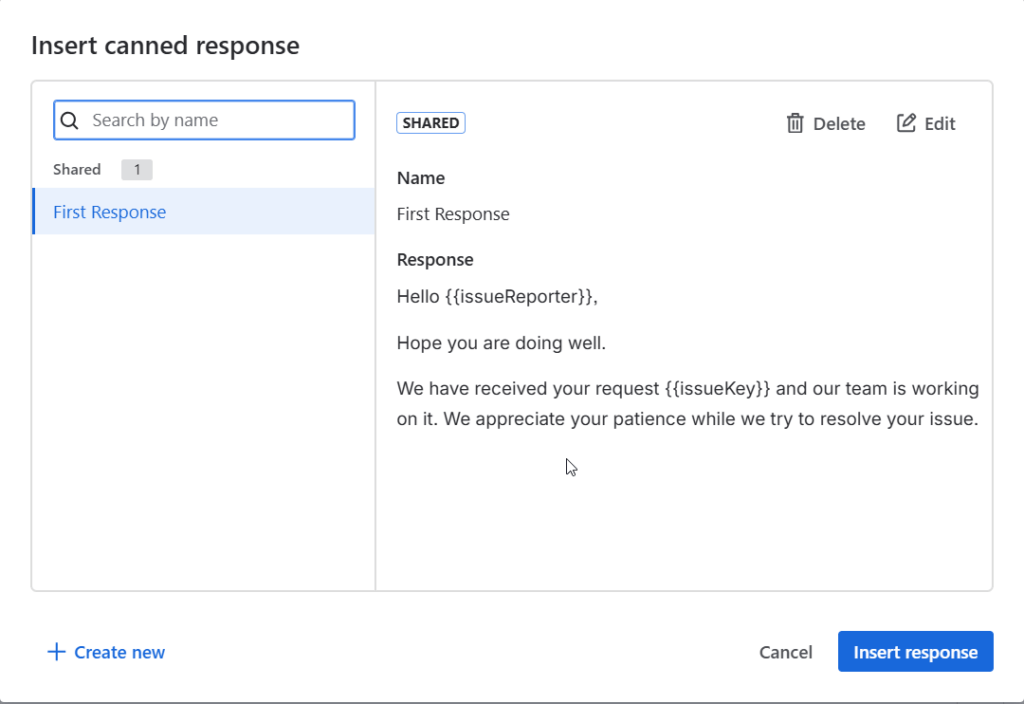
Canned Responses
Canned responses are pre-written messages that agents can quickly send to users. They are ideal for recurring requests and common questions. Benefits include:
- Saving time by reducing repetitive typing
- Providing consistent, accurate communication
- Ensuring a professional tone in every interaction
They’re a small feature, but they go a long way toward improving both efficiency and the user experience.
Playbooks
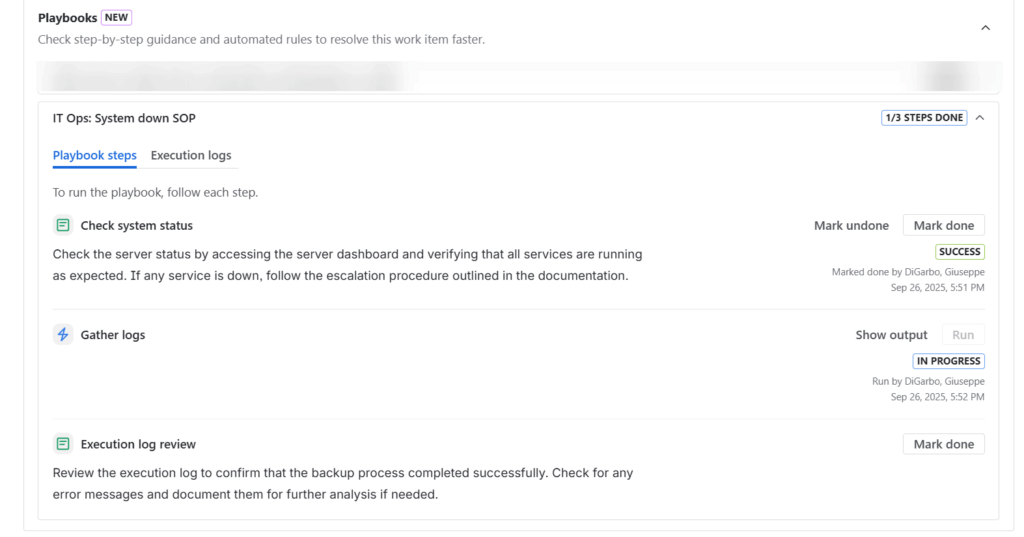
Playbooks are one of JSM’s newest features, and a game-changer for standardizing work. A playbook is essentially a step-by-step guide or automated workflow for handling recurring types of requests. Each playbook can include:
- Instructional steps: Clear instructions for manual actions agents must take
- Automation steps: Tasks that are automatically executed by the system
This ensures that every agent follows the same process, which is especially useful for high-volume or critical requests. It also aligns perfectly with ITIL4’s focus on standardization and automation to improve reliability and speed.
A playbook example
Recommendations for Success
Based on ITIL4 best practices, here are a few tips to make SRM implementations successful:
- Start with the most common requests and build playbooks around them first
- Empower users with self-service through the portal and knowledge base
- Automate repetitive tasks to free up your team for higher-value work
- Leverage simple features, like canned responses, for quick wins
- Monitor KPIs and user feedback to continuously refine and improve your service request processes
Conclusion
Service Request Management might seem routine, but it’s critical to keeping your IT services running smoothly and your users happy. By combining the ITIL4 framework with Jira Service Management’s powerful tools, you can create a streamlined, predictable, and user-friendly process for handling requests.
From advanced features like automation and SLAs, to simple but effective tools like canned responses and playbooks, JSM helps teams deliver better service while reducing effort and complexity.
The result? Faster fulfillment, more satisfied users, and a continually improving service experience.
References
- Atlassian, Create and Manage Playbooks
- Atlassian, Reply faster to you customer with Canned Responses
These Solutions are Engineered by Humans
Did you like this article? Does it reflect your skills? Würth Phoenix is always looking for talented, enthusiastic individuals to help us drive our business. In fact, we’re currently hiring for many different roles here at Würth Phoenix.

Giuseppe Di Garbo
Consultant at Würth IT Italy
Hi everybody. I’m Giuseppe and I was born in Milan in 1979. Since the early years of university, I was attracted by the Open Source world and operating system GNU\Linux. After graduation I had the opportunity to participate in a project of a startup for the realization of an Internet Service Provider. Before joining Würth Phoenix (now Würth IT Italy) as SI consultant, I gained great experience as an IT consultant on projects related to business continuity and implementation of open source software compliant to ITIL processes of incident, change and service catalog management. My free time is completely dedicated to my wife and, as soon as possible, run away from Milan and his caotic time and trekking discover our beautiful mountain near Lecco for relax and lookup the (clean) sky.
Author

Latest posts by Giuseppe Di Garbo
19. 12. 2025
Atlassian, Service Management
Jira Service Management Customer Detail Fields: A Practical Use Case
30. 06. 2025
Atlassian, Service Management
Creating Jira Service Management Requests from a Public Website? Here’s the Secure, No-API Way
28. 03. 2025
Atlassian, Service Management
Effortless On-Call Management with Jira Service Management
20. 12. 2024
Atlassian, NetEye, Service Management
Managing Alerts with JSM: Focus on Incident Management (Part 2)
22. 11. 2024
Atlassian, Service Management
Managing Alerts with JSM: Focus on Incident Management (Part 1)