
Google has recently changed its API access policies; since June 11, 2018, the use of the API private key has been mandatory.
In NetEye’s NagMap application, access to the Google Maps data has thus stopped, resulting in error alerts like this:
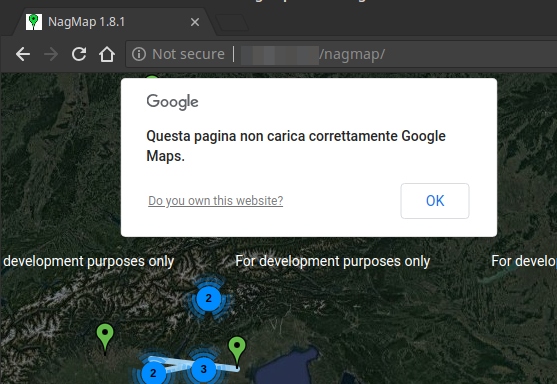
In order to gain access to Google Maps data, you must obtain an API Key as described here:
https://developers.google.com/maps/documentation/javascript/get-api-key
Then NagMap must be told to use the newly generated key, which you can do by editing the following file:
/var/lib/neteye/plugins/nagmap/config.php
Just add a line before the PHP closing tag ?> as shown below
// Use Clustering of Markers feature
$use_cluster_markers = 1;
$cluster_markers_gridSize = 20;
$cluster_markers_maxZoom = 15;
$API_KEY=”key=xXXxxxXXXxxx-XXXxxxXXXxxXXXXxx”;
?>
If you need specific help either to create the API key, or to configure NetEye to use it, feel free to contact our Support Team at: net.support@wuerth-phoenix.com
We are sorry to depend so heavily on the Google API. We will work out a better solution in the near future.


Oreste Attanasio
Team Leader Service & Support at Würth IT Italy
I graduated in Applied Computer Science at the University of Bolzano in 2006. After 3 years of experience as consultant in a small IT business IT I decided to move on, and found Würth Phoenix as a good starting point for a career.
After serving several years as a developer, consultant and support engineer, I now lead the Service & Support Team and aim to deliver best quality services to our customers, by helping them using our products together with the strength of Open Source, in which I strongly believe.
Author

Latest posts by Oreste Attanasio
09. 03. 2021
Contribution, NetEye, Unified Monitoring
NeDi 1.9 security advisory
04. 02. 2020
NetEye, Service Management
Microsoft will Deny Plain LDAP Connections to AD Beginning March 2020
25. 03. 2019
Log Management, Log-SIEM, NetEye, Unified Monitoring
Safed improvements since 1.10.1
14. 07. 2016
NetEye
Accesso al nuovo portale service desk