
The Smith-Family is driving on the highway to arrive to their holiday destination in Italy, as a car in front of them suddenly brakes. A truck accidently has lost demolition debris and thereby almost caused a multiple-vehicle collision. Mrs. Jones is driving the car just behind the truck and as her car brakes, it simultaneously sends a message to the following vehicles. Those activate the brakes too, shift down and forward the message to the cars behind them. In this way, also the following cars can immediately react. An accident has been successfully avoided and all vehicles can go ahead. Moreover, the truck informs the highway company, who instantly sends the cleaning crew.
At the first moment, this might seem since-fiction, but it isn’t. We call it: IoT (Internet of Things).
I am personally convinced that for Information Technology this topic will become the major business opportunity of our century. Today we assume that within 2020 the number of “connected” IoT devices will increase from current 1 billion to 26 billion. [1]
Countless opportunities
Cars converging on an intersection may communicate with a centralized system that efficiently manages the traffic lights. Agricultural fields may be monitored for humidity, solar irradiation or fertilizer. Sensors on mountains may forecast avalanches and recognize mountaineers in distress. Possibilities are infinite…
IoT today
The above-mentioned examples are still up in the air, but for us at Würth Phoenix IoT is already reality. Today, thanks to the LoRA and the MQTT protocols, we are now able to manage data from different sources (sensors). But that’s not all: The collected data is elaborated, indexed, saved and graphically visualized through modern open-source tools. Thanks to the Elastic Stack and Grafana we bring IoT monitoring to the next level and enable detailed analysis to forecast problems.
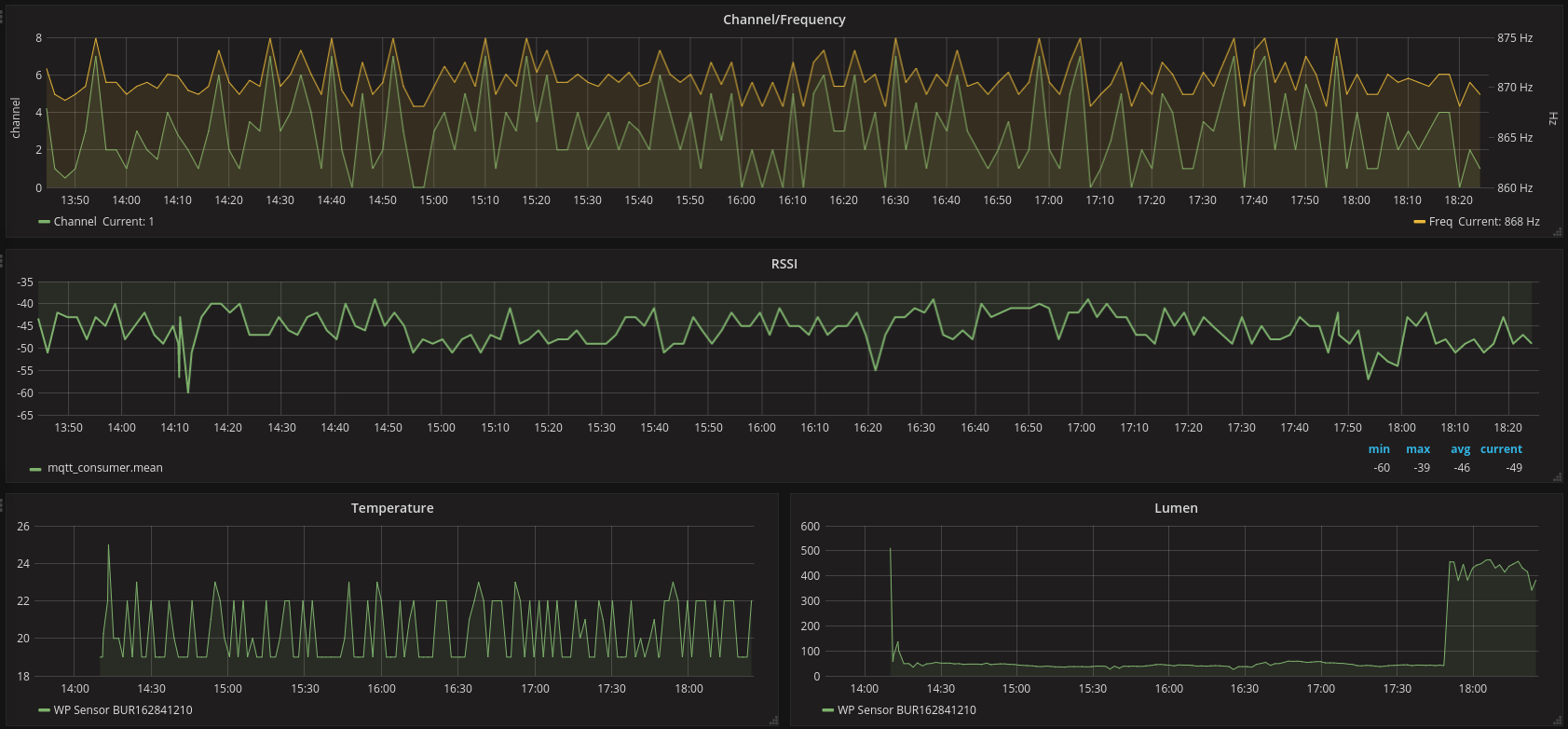
The obtained results are surprising and the ideas we are working on are grand. Move with us towards the future, today!
[1] http://www.gartner.com/newsroom/id/2636073



Massimiliano De Luca
Consultant at Würth Phoenix
Hi, my name is Massimiliano and I'm the youngest SI Consultant in Würth Phoneix (or my colleagues are very old).
I like: my son Edoardo (when he doesn’t cry), my pet-son Charlie, photography, mountains, linux os, open-source technology and everything I don't know.
I don't like: giving up, the blue screen of Windows, the buffering while I’m watching a movie, latecomers and fake news on internet.
I worked for the VEGA project of the European Space Agency and now I'm very happy about being landed in this company.
I'm ready to share all of my knowledge and my passion whit our customers.
Author

Latest posts by Massimiliano De Luca
21. 12. 2017
NetEye
The Importance of Naming Convention in NetEye
30. 05. 2017
NetEye
IoT: il futuro, oggi.
30. 05. 2017
NetEye
IoT: Die Zukunft ist jetzt