
Director is one of the most important modules in NetEye 4 because it’s used for managing, automating and deploying the configurations of all monitored objects.
In all our projects we use automation in Director: through the Import and Synchronization rules we can automate many operations such as the import and synchronization of hosts, service checks, users, custom variables, notifications and much more from external data sources (i.e., MS Active Directory, CMDBs, Databases, and JSON files).
The Import and Synchronization rules can also be scheduled via appropriate Jobs.
Furthermore, through a Job it’s also possible to schedule the automatic deployment of configurations.
In contexts where these automation and integration processes from external data sources are in use, it’s therefore very important to monitor the health of all these components.
How Can We Do It?
Director provides health checks not just through the Health page, but also through the Director CLI.
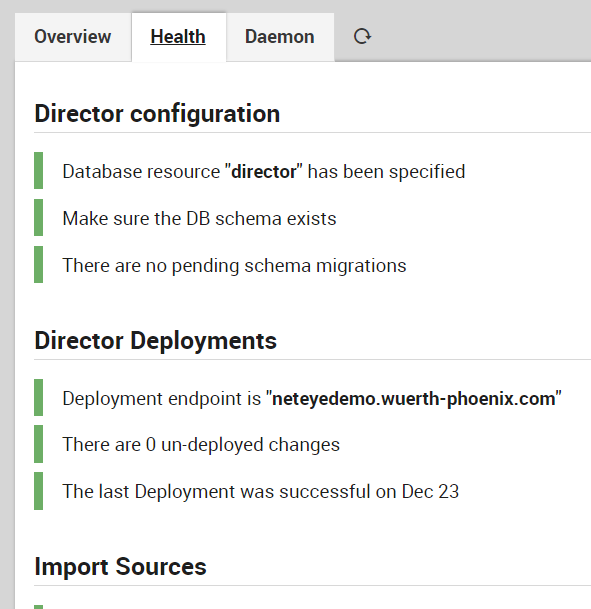
Thanks to the Director CLI we can carry out an in-depth monitoring of these components:
- Config: Configuration, Schema, Migrations
- Sync: All configured Sync Rules (pending changes are not a problem)
- Import: All configured Import Sources (pending changes are not a problem)
- Jobs: All configured Jobs (ignores disabled ones)
- Deployment: Deployment Endpoint, last deployment outcome
Here’s some sample output of a complete health check from the command line:
[root@neteyedemo ~]# icingacli director health check
Icinga Director: everything is fine

Director configuration: 3 tests OK
[OK] Database resource 'director' has been specified
[OK] Make sure the DB schema exists
[OK] There are no pending schema migrations

Director Deployments: 3 tests OK
[OK] Deployment endpoint is 'neteyedemo.wuerth-phoenix.com'
[OK] There are 0 un-deployed changes
[OK] The last Deployment was successful on Dec 23

Import Sources: 4 tests OK
[OK] 'nx-is-datalist-neteye-modules' is in sync
[OK] 'nx-is-neteye-infrastructure-endpoints' is in sync
[OK] 'nx-is-neteye-infrastructure-zones' is in sync
[OK] 'test' is in sync

Sync Rules: 4 tests OK
[OK] 'nx-sr-datalist-neteye-modules' is in sync
[OK] 'nx-sr-neteye-infrastructure-endpoints' is in sync
[OK] 'nx-sr-neteye-infrastructure-zones' is in sync
[OK] 'nx-sr-neteye-ip-duplicated-zones' is in sync

Director Jobs: 2 tests OK
[OK] 'nx-j-import-datalist-neteye-modules' is fine
[OK] 'nx-j-sync-datalist-neteye-modules' is fine
You can find the complete documentation of the CLI here.
Conclusion
It’s really important to monitor your automated tasks in Director in order to better understand if our NetEye Master host is working properly or not.
Using the Director CLI, we added a command and some service checks to extend the self monitoring of the NetEye Master host including every aspect of the automation tasks. The final result will be the following service checks:
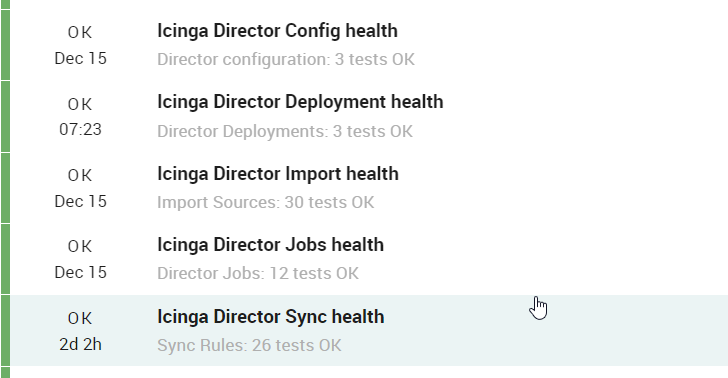
These controls are already available in the Monitoring Core module NEP starting from the NetEye 4.27 release.
These Solutions are Engineered by Humans
Did you find this article interesting? Are you an “under the hood” kind of person? We’re really big on automation and we’re always looking for people in a similar vein to fill roles just like this and other roles here at Würth Phoenix.



Giuseppe Di Garbo
Consultant at Würth IT Italy
Hi everybody. I’m Giuseppe and I was born in Milan in 1979. Since the early years of university, I was attracted by the Open Source world and operating system GNU\Linux. After graduation I had the opportunity to participate in a project of a startup for the realization of an Internet Service Provider. Before joining Würth Phoenix (now Würth IT Italy) as SI consultant, I gained great experience as an IT consultant on projects related to business continuity and implementation of open source software compliant to ITIL processes of incident, change and service catalog management. My free time is completely dedicated to my wife and, as soon as possible, run away from Milan and his caotic time and trekking discover our beautiful mountain near Lecco for relax and lookup the (clean) sky.
Author

Latest posts by Giuseppe Di Garbo
19. 12. 2025
Atlassian, Service Management
Jira Service Management Customer Detail Fields: A Practical Use Case
29. 09. 2025
Atlassian, Service Management
Streamlining Service Request Management with ITIL4 and Jira Service Management
30. 06. 2025
Atlassian, Service Management
Creating Jira Service Management Requests from a Public Website? Here’s the Secure, No-API Way
28. 03. 2025
Atlassian, Service Management
Effortless On-Call Management with Jira Service Management